Fleet Rollout Review Records
A fleet branding rollout record should show why a direction was retained, revised, or sent for confirmation. Review the vehicle profile first, then hold the viewing condition steady while you inspect hierarchy, panel geometry, revision changes, and open handoffs.
It is not a gallery of attractive mockups. It is a comparable account of what the concept shows, what the reviewer decided, and which project-specific questions still require current records.
Comparable first. Decisive second.
What the record needs to establish
A useful record answers six questions without turning a concept observation into a production fact:
- Which vehicle profile and concept-stage mockup were reviewed?
- Under what viewing condition was each comparison made?
- Which element led the hierarchy, and which elements competed with it?
- How did body lines, panel breaks, doors, glass, and wheel arches affect the composition?
- What changed between revisions, and what visible consequence followed?
- Which questions remain open, who owns them, and what current record can resolve them?
These fields let a later reviewer reconstruct the decision instead of guessing from filenames, comments, or memory. Keep three statuses separate:
- Observable finding: what appears in the mockup under a stated condition.
- Design decision: the direction selected for the next comparison or review round.
- Project confirmation: a measurement, permission, specification, or check supplied by the responsible party.
A logo crossing a door seam is observable. Moving it upward is a design decision. Whether the new position fits the measured panel and selected material system still requires project-specific confirmation.
Begin with a controlled vehicle profile branding comparison
Comparisons lose value when the vehicle, angle, crop, lighting, or display scale changes between variants. The reviewer can no longer tell whether the different read comes from the design or from the presentation.
Build each direct comparison around one controlled condition:
- the same make, model, body configuration, and profile reference;
- the same side, front, rear, or three-quarter angle;
- the same crop and apparent vehicle size;
- the same background treatment where practical;
- the same stated viewing distance or display scale;
- the same visibility of doors, glass, handles, lamps, and wheel arches.
Then change one meaningful variable at a time. That variable might be logo scale, colorway, graphic direction, sponsor tier, lower-body coverage, or the relationship between a wordmark and a contour.
One comparison, one question.
If Variant A changes color, logo position, typography, and sponsor count together, the record cannot isolate the cause of the different read. Use a grouped comparison only when the entire direction is under review, and identify it as a grouped decision.
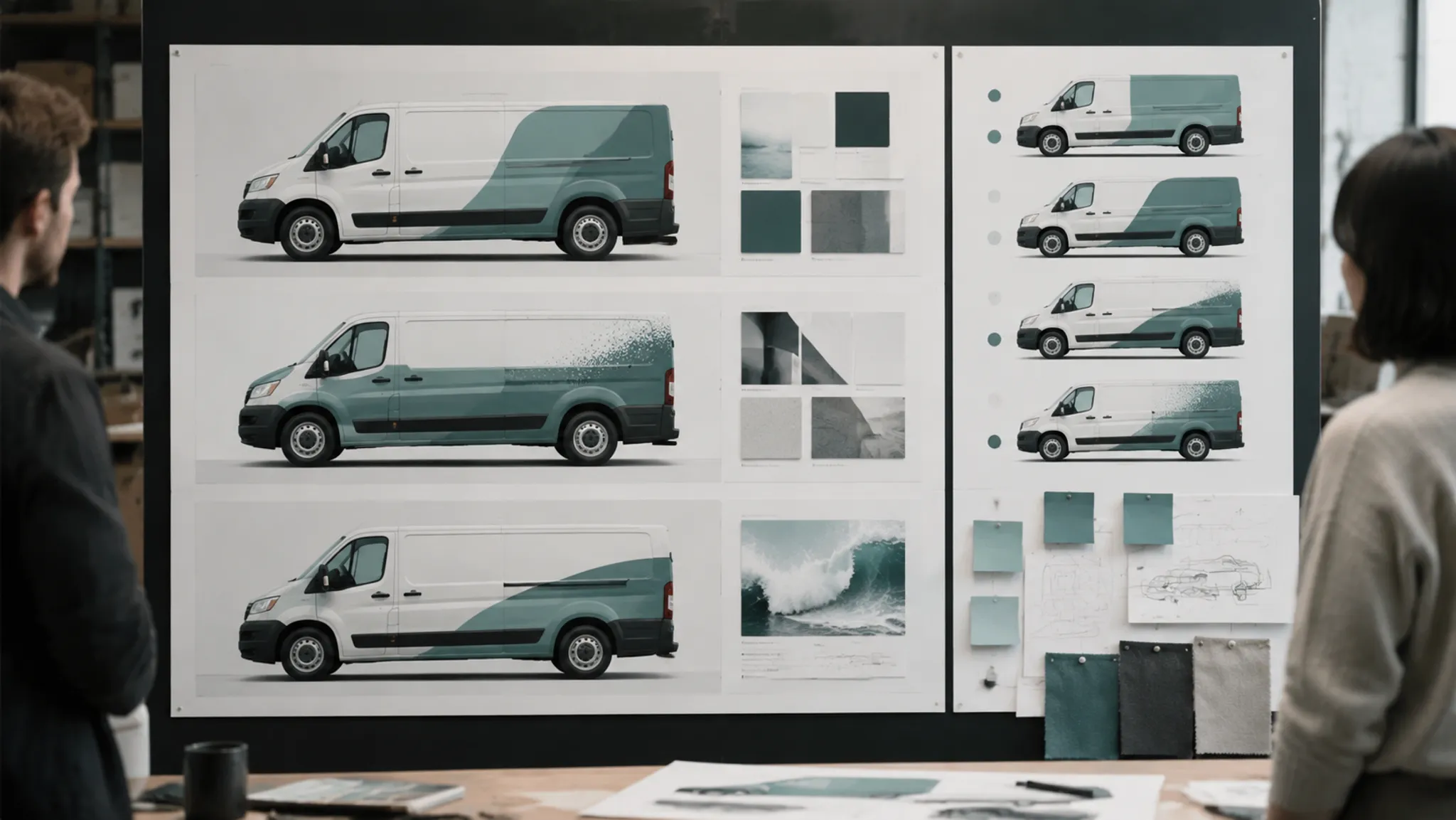
Condition: Concept-stage left-side profile, stationary view, matched scale.
Observed difference: Variant A keeps the primary mark above the main body line. Variant B extends it across the front door seam.
Visible effect: Variant A reads as one uninterrupted mark. Variant B occupies more area but divides at a high-attention boundary.
Decision: Retain Variant A for the next vehicle-profile comparison.
Open confirmation: The designer updates the vehicle-specific mockup; the installer confirms treatment around the measured seam using current production documentation.
This format stays narrow. It records what the concept demonstrates and routes the remaining question to the correct handoff.
Record fleet branding viewing conditions
A concept can hold together in a close stationary review and weaken when reduced or seen from another angle. Every judgment should therefore name the condition behind it.
Stationary close view
Use the close view to inspect relationships with panel geometry. Look for marks approaching door seams, handles, fuel doors, wheel arches, glass lines, lamps, and strong contours. Record the visible interaction without assuming measured fit.
At this distance, secondary copy and small sponsor marks may appear orderly. That result does not establish how they read at distance or in motion.
Stationary distance view
Reduce the mockup consistently and check which elements remain distinct. The purpose is to compare hierarchy under the same reduction, not to claim an exact real-world viewing distance unless the display method has been documented.
Record which element is recognized first, which becomes ambiguous, and which disappears into adjacent color or geometry. A secondary line may disappear without harming the intended hierarchy. A primary fleet identifier that loses separation needs another review.
Angle change
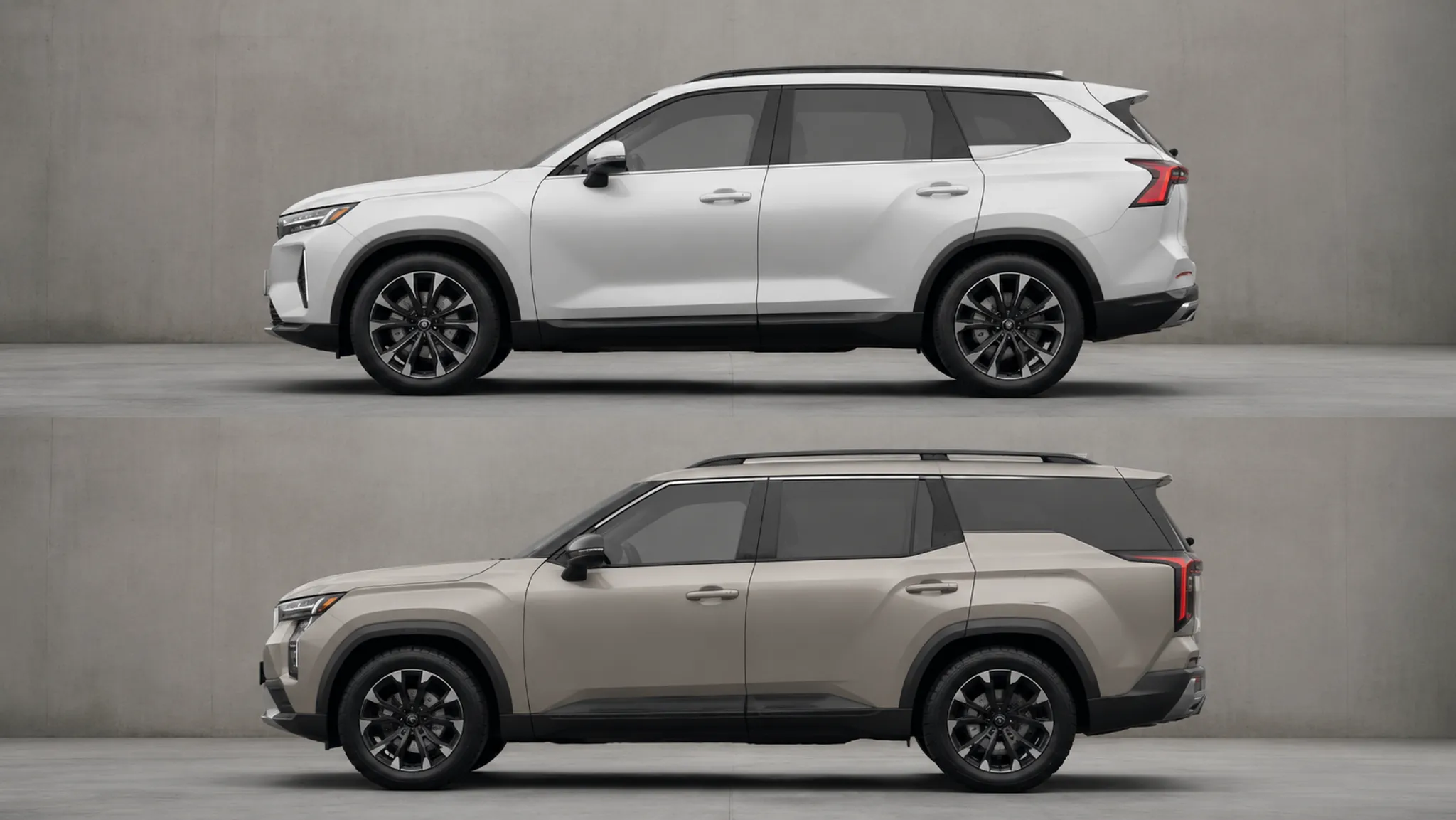
Move from side profile to front, rear, and three-quarter views using vehicle-specific mockups. A broad side graphic may compress around a rear corner, while a front-door mark may gain or lose prominence when the nose enters the frame.
Do not generalize from one angle. State the profile.
Motion-oriented review
A concept-stage motion view can reveal changes in apparent hierarchy, but it does not establish visibility or safety performance. Record only the observable result under the stated presentation condition, such as whether the primary identifier remains separate while secondary content merges.
Current local requirements, operating conditions, and visibility-related criteria require confirmation through applicable sources and responsible-party records.
Review hierarchy before surface coverage
Fleet branding hierarchy decisions concern the order in which visual information presents itself. More coverage does not necessarily create a clearer identity. Ask whether each tier has a distinct role under the same viewing condition.
- Primary tier: fleet or brand identifier.
- Secondary tier: service descriptor, campaign line, vehicle class, or team identity.
- Supporting tier: unit number, operational label, sponsor group, or required project information.
- Detail tier: small marks or text intended mainly for close viewing.
The exact tiers depend on the project. Record the intended order before judging the layout, because two reviewers may otherwise evaluate different goals.
Research on vehicle liveries and visual brand recognition offers bounded support for examining repeated visual features alongside exterior form and viewer interpretation. Broader product-design research also describes a tension between recognizable family cues and design variation. These sources provide a comparison frame; they do not set a universal logo size, contrast threshold, or vehicle-layout rule.
Test the hierarchy directly:
- Name the element that attracts attention first.
- Name the element intended to lead.
- Record whether those answers match.
- Identify the competing feature if they do not.
- Change one variable and repeat under the same condition.
Competition may come from a bright color block, a large secondary word, a high-contrast sponsor mark, or a contour that cuts through the identity. “The layout feels busy” is not enough for a revision record.
A more useful note reads: “At the reduced side-profile view, three secondary marks approach the primary wordmark in contrast and apparent size, weakening its lead.” The note gives the designer a specific condition to compare.
Connect panel geometry to the decision
Panel geometry is not a final production map in a concept review. It is the visible structure shaping the composition and showing where current measurements or installer input will be needed.
- Does a wordmark divide at a door seam?
- Does a graphic tangent appear to collide with a wheel arch?
- Does a color transition follow or fight a dominant body line?
- Does an identifier approach glass, a handle, a lamp, or a recessed area?
- Does a contour compress spacing in a three-quarter view?
- Does a rear-door split change the order of information?
Lead with the visible tradeoff. A graphic that follows the body line may produce stronger continuity on one profile but require a different proportion on a taller vehicle. A fixed-size mark may support consistency in the review set yet appear weak on a larger side panel.
Neither direction wins universally. The record should explain which consistency principle matters: identical artwork scale, comparable visual prominence, shared alignment, repeated color ratio, or a stable hierarchy adapted to each body.
Applying the same coordinates across different silhouettes is not the same as preserving the same visual system.
Compare variants across a mixed fleet
After resolving a question on one profile, compare the selected direction across representative vehicle types. Keep the brand system stable while allowing each silhouette to show where adaptation is necessary.
| Vehicle profile | Primary read | Geometry conflict | Variant change | Open confirmation | Owner |
|---|---|---|---|---|---|
| Compact van | Primary mark leads at reduced side view | Rear edge approaches door split | Shifted forward in Revision 03 | Confirm measured clear area | Designer and installer |
| Long-wheelbase van | Color field leads before the mark | Main contour crosses sliding-door region | Reduced color-field height | Confirm current panel map | Designer and vehicle owner |
| Box body | Mark appears small relative to side area | No visible conflict in profile mockup | Scale comparison requested | Confirm dimensions and production limits | Producer and installer |
Examples that are not tied to documented project material should be labeled concept-stage or hypothetical. The matrix records design reasoning; it does not establish vehicle fit, material behavior, or installation feasibility.
Fixed identity versus adaptive layout
A fixed identity keeps selected features unchanged across vehicles. An adaptive layout preserves hierarchy and family resemblance while adjusting placement or proportion to the profile.
Compare both directions under matched conditions. The fixed variant may create stronger repetition across fleet thumbnails but interact poorly with certain panel breaks. The adaptive variant may respect each silhouette yet drift if too many recognizable cues change.
Name the protected cues. They might include the primary mark relationship, a color boundary, a graphic direction, or spacing between identity tiers. Research on recognition and variation helps frame the tradeoff, but the acceptable balance remains specific to the brand, fleet, and review goal.
Write revision records that preserve reasoning
A revision number without a reason is only file management. A reviewable history connects the observed issue to the change and its result.
Each entry should contain:
- revision identifier and review date;
- vehicle profile and mockup view;
- previous condition;
- requested change and reason;
- observable result under the repeated condition;
- decision status;
- unresolved question and responsible owner;
- related current document, when one exists.
Avoid notes such as “make logo bigger” or “try a cleaner version.” State the intended consequence: “Increase separation between the primary mark and secondary descriptor at the reduced side-profile view.”
When the revised mockup returns, record whether that consequence appeared. The new version may improve hierarchy while creating a panel-geometry conflict. Keep both findings. Revision records preserve tradeoffs rather than rewriting the history as a straight path to one concept.
Rejected variants
Retain enough information to prevent a rejected direction from returning without context. A thumbnail, condition, concise finding, and decision reason are usually sufficient.
For example: “Variant B was not carried forward because the diagonal field overtook the primary identifier at the matched distance view. Its stronger wheel-arch relationship was noted but did not resolve the hierarchy conflict.”
That is a usable verdict. It identifies both the weakness and the benefit that was sacrificed.
Keep unresolved questions visible
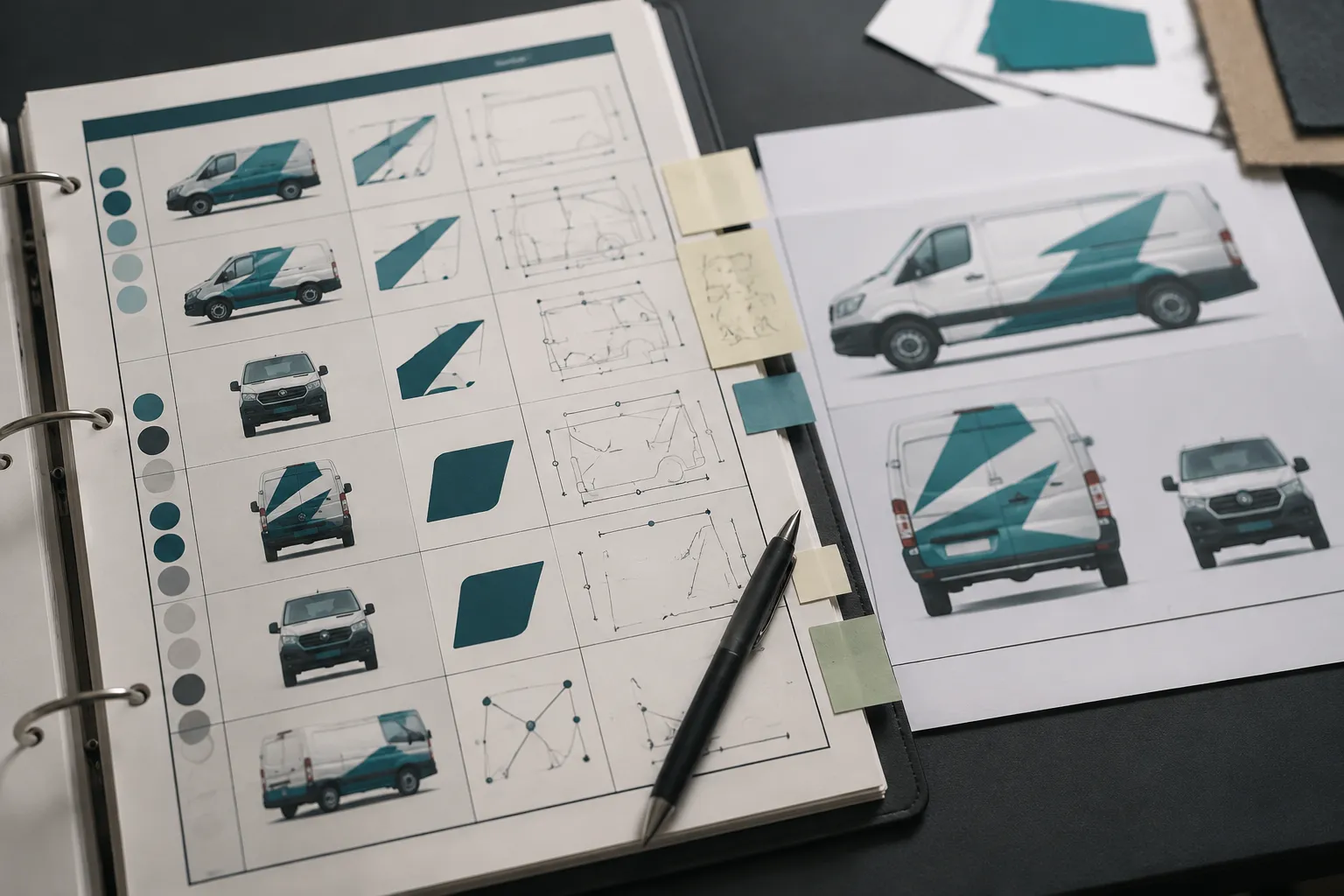
Open questions should not disappear inside general comments. Give each one a category, owner, required evidence, and status.
| Question category | What the review can record | Who should confirm | Confirmation record |
|---|---|---|---|
| Vehicle geometry | Visible relationship in the mockup | Designer, vehicle owner, or installer | Current measurements or panel map |
| Material behavior | Intended visual treatment | Producer, installer, or manufacturer documentation | Current material and application specification |
| Trademark or sponsor use | Mark shown and intended tier | Rights holder or sponsor representative | Documented permission or sponsor record |
| Local road-use requirement | Area or element requiring review | Applicable responsible party | Current local source or project record |
| Color and print | Intended color relationship in the concept | Producer and brand owner | Current color specification and print verification record |
| Installation detail | Visible crossing, recess, edge, or seam | Installer | Vehicle-specific installation review |
| Final handoff status | Completed and open checks | Named project owner | Preflight and sign-off records |
An owner must be able to answer the question. “Production” is too broad when separate people control artwork preparation, printing, and installation. Use the role used by the project.
A due date can support coordination, but it does not replace evidence. Close an item by pointing to the current confirmation record, not by changing its label after a meeting.
Common mix-ups at the review desk
Preference versus finding
“Variant A looks better” does not preserve a criterion. Identify the observable difference and consequence: stronger separation, clearer tiering, continuity across a panel break, or better family resemblance at the compared scale.
Unmatched mockups
A dramatic three-quarter render and a flat side elevation answer different questions. Use each view, but do not treat them as a controlled comparison.
Consistency versus identical placement
Different profiles can require different layouts to preserve a stable read. Record which cues remain fixed and which adapt.
Convincing render versus completed handoff
A mockup can support a concept decision. It does not establish measurements, permissions, local requirements, material suitability, print accuracy, preflight completion, or installation acceptance.
Comments versus decisions
A long comment thread may contain several opinions and no retained direction. End each checkpoint with a decision, a requested comparison, or an assigned confirmation.
Artwork filename versus status record
Labels such as “final,” “latest,” or “ready” do not show which dependencies remain open. Use controlled revision identifiers and a separate status field.
A worked hypothetical mockup critique
Consider two concept-stage variants shown on the same long-wheelbase van profile at matched scale.
Variant A places the primary wordmark above the main body line and keeps a low-contrast color field below it. Variant B enlarges the field, moves the wordmark downward, and adds three supporting marks near the rear wheel arch.
At the close side view, Variant B creates a stronger relationship between the color field and lower contour. At the reduced view, however, the field leads before the wordmark, while the supporting marks form a second high-contrast cluster.
The hierarchy has split.
The visible tradeoff is greater lower-body presence against weaker separation between primary and supporting tiers. A useful next comparison would retain Variant B’s contour relationship while reducing one competing variable, such as supporting-group contrast or density.
The record should not claim that Variant A is universally more legible. It should state that, in this mockup and at this matched reduced view, Variant A preserves a clearer primary lead.
Keep the open confirmations separate:
- Designer: prepare the controlled revision and repeat the same views.
- Rights holder: confirm permitted marks and supplied artwork.
- Vehicle owner: provide current vehicle identification and measurements.
- Producer: confirm current file, color, and print requirements.
- Installer: review vehicle-specific seams, recesses, edges, and application constraints.
- Project owner: maintain the confirmation record and decision status.
The review record turns critique into a traceable next action without overstating what the concept proves.
Evidence boundary
The available research is strongest on visual identity, recognition, design consistency, and the tension between recognizable cues and variation. A study comparing rail and road vehicle liveries directly connects brand identity with vehicle exterior characteristics and viewer perception. Shared-mobility research reports study-specific concerns around inconsistent fleet branding, recognition, and user feedback, but those findings should not be generalized to every fleet.
The reviewed material is much weaker for the project details that determine production outcomes. It does not supply vehicle-specific measurements, current local road-use requirements, manufacturer material guidance, rights permissions, preflight records, print verification, or installer sign-off for a particular rollout.
Use research to frame questions about identity and consistency. Use current project documents and responsible-party records to resolve measurements, materials, permissions, production, and installation.
Fleet branding rollout record checklist
- A labeled concept-stage mockup and identified vehicle profile.
- Matched conditions for every direct variant comparison.
- The intended identity or sponsor hierarchy.
- Observable findings tied to a specific view and scale.
- Panel-geometry relationships that need attention.
- The visible benefit and cost of the selected direction.
- Revision identifiers and reasons for each material change.
- Rejected directions with concise decision reasons.
- Unresolved questions separated from visual decisions.
- A named owner and required record for each confirmation.
- A clear next handoff without implying production completion.
A useful fleet branding rollout record does not try to settle every downstream issue at the concept desk. It preserves comparable evidence, makes the visual decision understandable, and sends each remaining question to the person who can document the answer.
Record the condition. Name the tradeoff. Assign the confirmation.
Sources
- Branding identity, development and application: a comparison of rail and road vehicle liveries
- Visual Communication in Shared Mobility Systems as an Opportunity for Recognition and Competitiveness in Smart Cities
- Designing Visual Recognition for the Brand
- Balancing design freedom and brand recognition in the evolution of automotive brand styling
- A semantic approach to the relationship between brand identity and exterior product design for visual brand recognition, through a case study on local commercial vehicle brand, Temsa
- Leveraging Brand Equity for Effective Visual Product Design