Adapting a Cargo-Van Fleet Graphic to a Pickup
A cargo-van graphic can move to a pickup, but it should be rebuilt around the pickup profile rather than stretched to its overall length. Start by checking whether the logo, sponsor tier, copy, and main color blocks keep their hierarchy across the glass line, door seams, wheel arch, bed break, and panel edges.
Use the van treatment as the identity reference. Use the pickup as a new graphic surface. The mockup can settle visual direction; vehicle-specific measurement, rights review, preflight, and installer confirmation still belong to the next handoff.
Start With a Matched Comparison
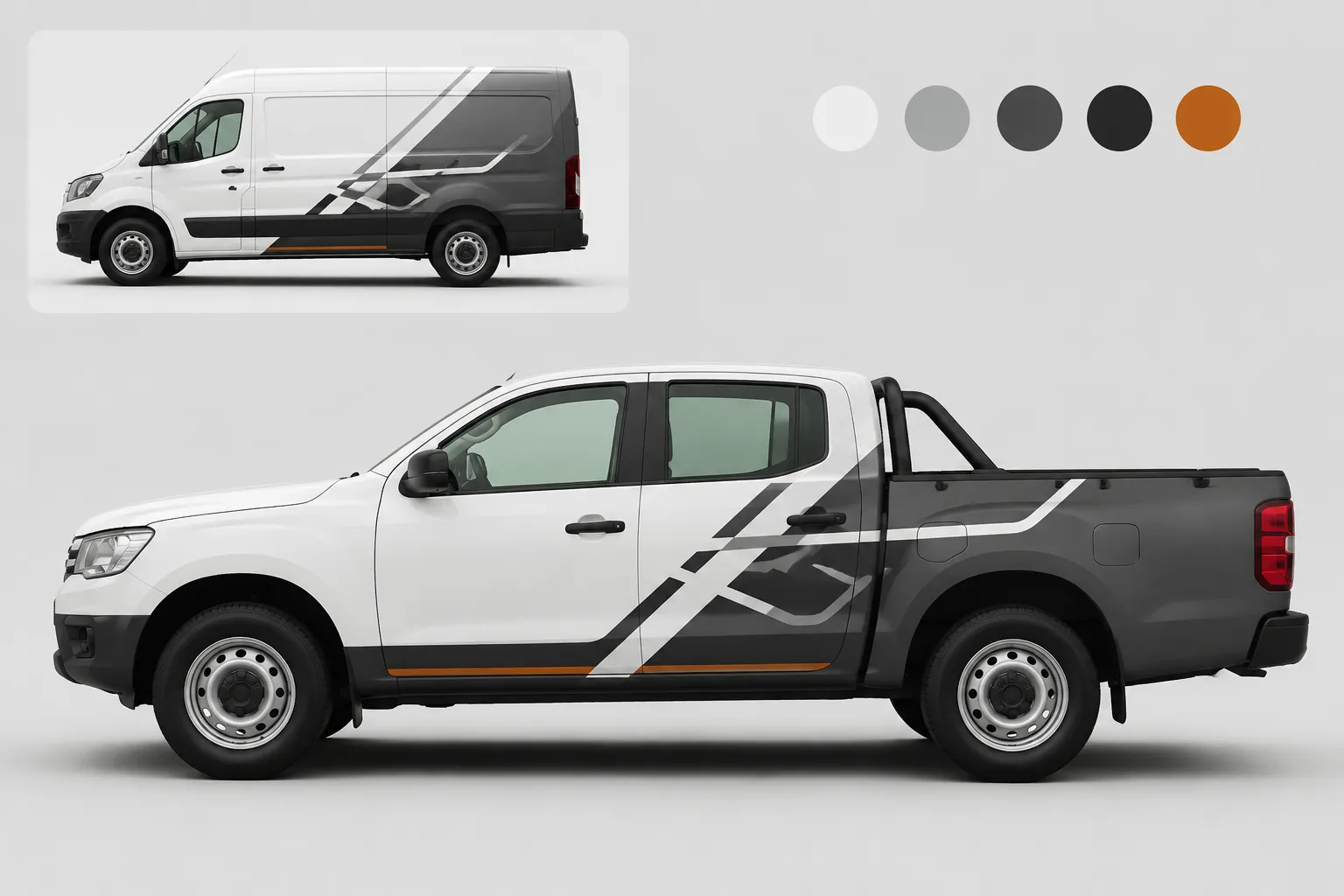
Place the original cargo-van graphic and the pickup adaptation in the same mockup format. Keep the view, presentation scale, background, and stated viewing condition consistent so the comparison reveals layout changes rather than presentation changes.
Begin with the driver-side profile, then inspect the opposite side if the design is not symmetrical. Record what remains fixed and what has moved.
- Primary logo position and size
- Sponsor tier and order
- Essential service copy or contact line
- Main color relationships
- Repeated fleet motifs
- Recognition cues shared across the van fleet
- Relationship between the graphic, cab, bed, wheel openings, and body lines
At close range, an adaptation may look faithful because every individual element is still present. The stronger test is whether those elements remain grouped and recognizable across the full pickup profile.
The pickup profile sets the hierarchy.
A van often offers one broad, continuous side area. A pickup divides that field between the cab, bed, wheel arch, doors, handles, glass, and possibly separate bed treatment. A graphic that depended on one uninterrupted panel can lose its structure when transferred.
Inspect the Body Lines Before Moving Artwork
Do not begin with a proportional resize. First mark the transitions that may interrupt the message or split a visual unit.
- Lower glass line
- Front and rear door seams
- Door handles and recesses
- Wheel arches
- Bed side and bed break
- Panel edges and major contours
- Compound curves and recessed areas
- Visible trim, steps, caps, or accessories
These marks are concept-stage review points, not merely production notes. A logo centered on a cargo-van panel may land across a pickup door seam. A horizontal color block may rise toward the glass line on the cab but sit lower on the bed. A secondary sponsor mark may become isolated when the bed creates more space around it.
| Pickup feature | Mockup observation | Decision to record |
|---|---|---|
| Door seam | Breaks the logo or separates symbol from wordmark | Move, reduce, or keep the logo on one panel |
| Wheel arch | Removes part of a continuous color field | Shape the field around the arch or document the offset |
| Bed break | Creates a separate visual zone | Repeat, simplify, or redistribute the hierarchy |
| Glass line | Changes the apparent height of the graphic | Align the main body line to the pickup profile |
| Panel edge | Interrupts a border or stripe | End the element before the edge or send the approach to production review |
Preserve the Fleet System, Not Every Van Dimension
Fleet consistency depends on the rules that make vehicles belong together. It does not require every body type to carry identical artwork proportions.
Keep the identity decisions visible:
- Which mark is always primary?
- Which color relationship identifies the fleet?
- Which copy is essential?
- Which sponsor receives the most visual space?
- Which stripe, angle, border, or repeated motif carries across vehicles?
- Which elements may change when the body shape changes?
A documented identity system can separate fixed logo, color, type, and composition rules from layout elements that may adapt across media. The pickup may keep the logo on the cab while the bed carries a shortened color field or secondary mark. The owner’s identity rules and the vehicle profile determine whether that arrangement is defensible.
Consistency is not duplication.
A useful adaptation preserves recognition cues while allowing body transitions to determine spacing and grouping.
Compare Two Pickup Variants
When the direction is uncertain, create two controlled variants and change one main layout decision at a time. Hold the viewing angle and evaluation criteria steady.
Variant A: Cab-Led Hierarchy
Place the primary logo and essential message on the cab doors or the largest uninterrupted door area. Continue a color block or graphic motif into the bed without placing essential copy across the transition.
This arrangement makes the cab the recognition zone and gives the bed a supporting role. The tradeoff is reduced use of the pickup’s total side length, so a long van-style message may need shortening or separation.
Variant B: Full-Side Continuity
Carry the main color field or graphic direction from the cab into the bed. Keep the logo in one area while using the longer side profile to retain more of the van’s visual rhythm.
This arrangement may preserve more of the original treatment in a stationary mockup. The tradeoff is that the bed break, wheel arch, or seam can interrupt the sequence and distribute the message across separate zones.
At close range, Variant B may resemble the van more closely. At a stated distance or smaller profile view, Variant A may keep the primary recognition cue more directly. That is a mockup observation to test, not a universal performance result.
Check Logo Placement on the Pickup Profile
Judge the primary logo as one recognition unit: symbol, wordmark, clear space, and supporting copy. Inspect whether a seam separates its parts or whether the mark approaches a wheel arch, handle, glass line, or panel edge closely enough to appear crowded.
- Can the symbol and wordmark be seen as one unit?
- Does the logo sit on a stable body area?
- Does the surrounding space follow the identity rules?
- Does the bed create a competing visual zone?
- Does the logo remain primary after sponsor marks are added?
- Does it still read when the approval mockup is viewed at a smaller size?
Research on automotive graphic perception can provide language for discussing symbol marks, text marks, familiarity, and viewing conditions. It does not establish how a particular pickup graphic will perform on the road. Use it to frame the comparison, then record only what is observable in the shown profile and viewing condition.
Treat Wheel Arches and Seams as Graphic Boundaries
A broad van color field can become two separate shapes around a pickup wheel arch. The field may follow the opening, stop before it, or continue with a deliberate offset. Choose the option that preserves the hierarchy rather than automatically copying the van’s straight line.
The same distinction applies to door seams and recesses. A stripe may cross a seam visually in the mockup, but the producer and installer must confirm how the current artwork, material system, overlap approach, and panel layout address that area.
Installation guides from 3M and Avery Dennison describe contours, compound curves, recesses, seams, overlaps, panel edges, and surface preparation as production considerations. They help define questions for the handoff; they do not confirm this artwork’s fit, material suitability, print accuracy, or installation outcome.
Use Model-Specific Dimensions Before Sign-Off
A generic pickup template is not a measurement record. Confirm the exact vehicle before treating the mockup as a dimensional reference.
- Make and model
- Model year where relevant
- Cab configuration
- Bed length and configuration
- Side, rear, and accessory differences
- Measurement source and document version
- Areas excluded from the graphic
- Areas requiring installer review
A manufacturer layout book can provide a lead for body geometry and dimensions when the vehicle configuration matches. It cannot establish dimensions for a different make, model, cab, or bed. Confirm the working surface from current vehicle-specific information.
Read It at Distance
Review the adaptation in two conditions:
- A close stationary view for seams, spacing, logo integrity, and body-line conflicts.
- A smaller profile or stated viewing-distance view for hierarchy, recognition cues, and message grouping.
At the smaller view, identify the first element that signals the fleet. Then check whether the sponsor tier, service category, and secondary copy remain in the intended order.
If the bed becomes an isolated color field, the pickup may read as two unrelated graphic zones. If the cab carries too much copy, the message may feel crowded even though the complete vehicle offers more surface.
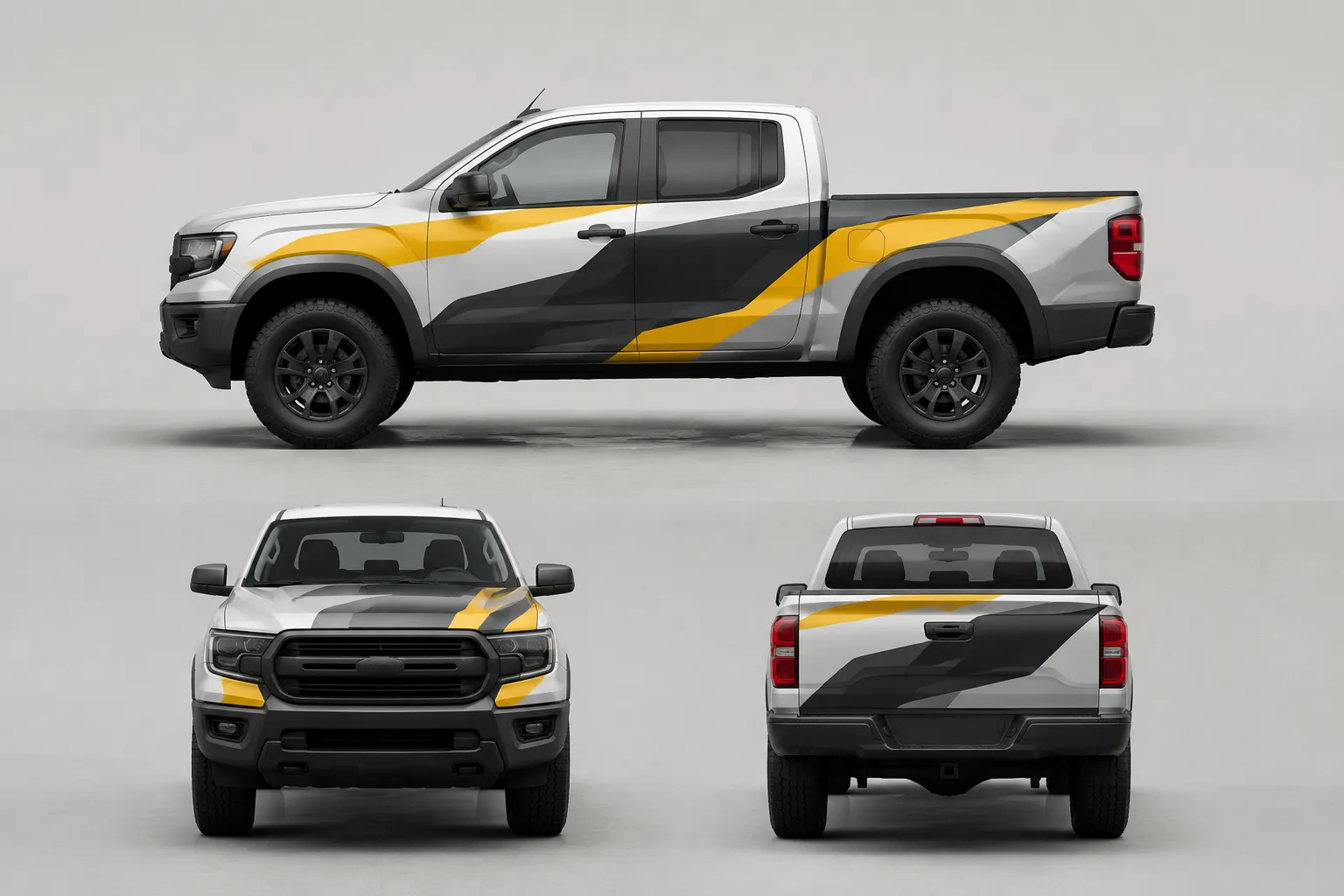
In the side-profile approval mockup, the cab retains the primary logo as one unit, while the bed carries the secondary color field without essential copy.
That sentence is specific to the shown vehicle profile and viewing condition. It does not establish recognition or visibility performance during road use.
Common Misunderstandings
“The van file only needs a proportional resize.”
Scaling preserves file dimensions, not relationships on the vehicle. The pickup introduces different panel breaks, contours, recesses, and visual zones.
“The same logo position works on every fleet vehicle.”
The same identity rule may require different physical placement. A position that works on a van can collide with a pickup seam or wheel arch.
“A manufacturer guide approves the design.”
Manufacturer guidance can describe installation vocabulary and technical checkpoints. It does not approve a specific design, vehicle, material system, or installation.
“A flat mockup proves the graphic will fit.”
A mockup can reveal hierarchy and body-line conflicts. It does not replace vehicle-specific measurement, preflight, material review, rights review, or installer confirmation.
Record the Handoff
End the review with a short decision record:
- Selected variant and reason for selection
- Primary logo location
- Elements moved, shortened, or removed from the cargo-van version
- Body transitions affecting the artwork
- Measurement source and exact vehicle configuration
- Sponsor or trademark questions for the rights holder
- File and color questions for the producer
- Seam, contour, recess, and panel questions for the installer
- Owner review status
- Next revision owner
The practical decision is whether the pickup adaptation preserves the fleet’s recognition structure on this specific body profile. Record that judgment in the mockup, attach unresolved measurement and rights questions, and route each item to the person responsible for confirming it.
Sources
- 3M Vehicle Graphics Installation Guide
- Avery Dennison Graphics Solutions Vehicle Wrapping Guide
- Ford Pro Body Builders Layout Book
- Automotive graphic sticker design: variation, interaction and perception
- Suggested considerations for creating a coporate style manual
- Manufacturer brand management in international distributor network