Vehicle-Class Variant Planning
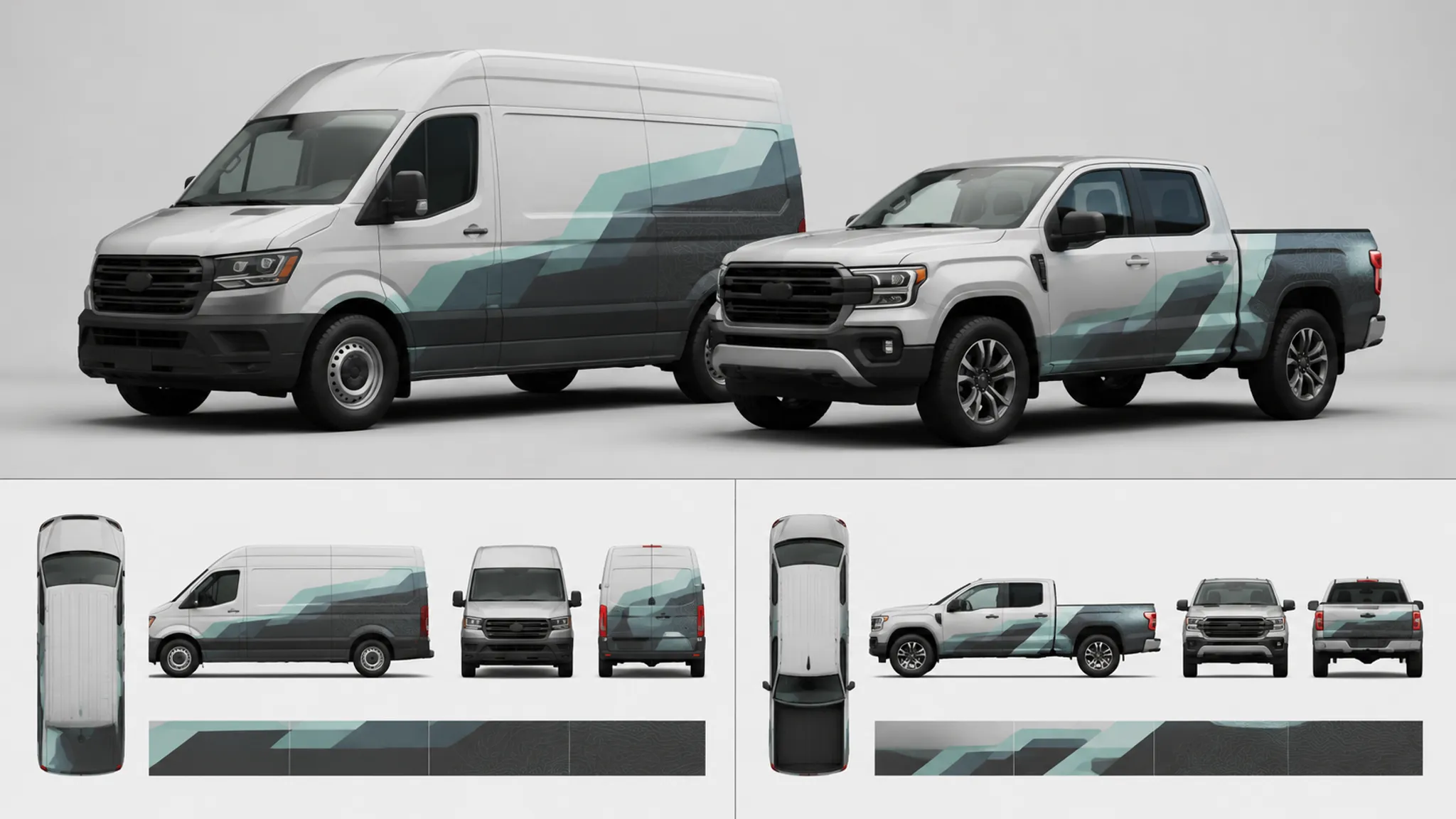
A fleet graphic can hold its hierarchy on a cargo van and lose it on a pickup. The colors may remain unchanged, yet the body lines, glass line, wheel arch, door seam, and available side area alter what the viewer reads first.
The working decision is not whether every vehicle should receive the same drawing. It is whether each vehicle-class variant preserves the same identity system under its own viewing conditions.
Keep the hierarchy; adapt the placement.
This page provides a review method for comparing fleet vehicle graphics across cargo vans, pickups, and related body shapes. It focuses on observable mockup decisions, repeatable checkpoints, and unresolved questions that belong with the designer, vehicle owner, producer, installer, rights holder, or applicable authority.
More specific pages
These pages continue the topic in smaller, more specific directions.
What Vehicle-Class Variant Planning Solves
Vehicle-class variant planning sits between a broad brand system and a single vehicle template. It does not define the whole brand, and it does not replace vehicle-specific production preparation.
Its narrower task is to:
- Identify the graphic elements that must remain recognizable.
- Identify the elements that may move, resize, shorten, or change form.
- Compare those choices across vehicle profiles.
- Record visible tradeoffs before production questions reach the responsible reviewer.
A cargo van usually presents a broad, relatively continuous side field. A pickup divides that field between the cab, bed, rear quarter, tailgate, and wheel arch. A box truck, service vehicle, or smaller utility vehicle creates another arrangement of body zones.
A long horizontal line may read as one band on a van and break into unrelated fragments on a pickup. A sponsor mark may sit comfortably between two doors on one profile but cross a handle, seam, or wheel arch on another.
Review the system as a group of related variants rather than one artwork repeatedly placed on different silhouettes.
Start With the Shared Graphic System
Before comparing body shapes, separate the graphic into levels of importance. This keeps minor decoration from competing with identity elements during adaptation.
- Primary identity: the company name, principal mark, or central team identity.
- Recognition structure: the main color relationship, recurring stripe, shape, or graphic gesture that helps the vehicles appear related.
- Information layer: phone numbers, web addresses, service descriptions, or other text the project has selected.
- Sponsor or partner layer: marks with defined placement or prominence requirements.
- Supporting detail: secondary lines, textures, patterns, accents, or class-specific decoration.
This hierarchy is a planning structure, not a production specification. The final size, location, and treatment of each element still depend on the vehicle, current files, measurement records, and project requirements.
The first comparison should ask whether the same element remains visually dominant on each profile. If the primary mark is large on the van but compressed beside the pickup bed, the system has changed even if the artwork appears on both vehicles.
Recognition comes before decoration.
Build a Vehicle-Class Variant Matrix
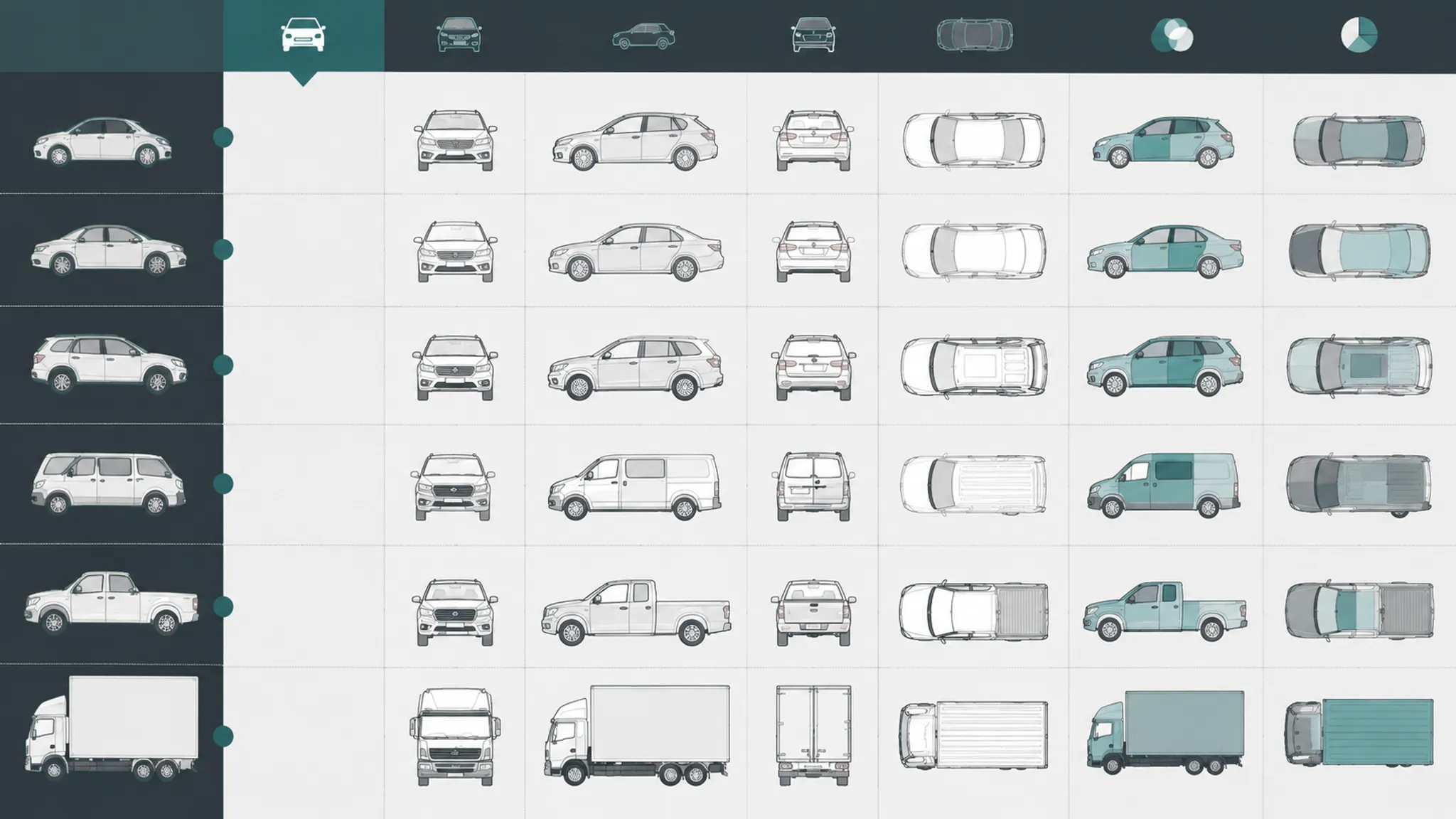
A variant matrix makes the comparison visible before detailed artwork expands. Use one row for each vehicle class and one column for each major graphic decision.
| Review area | Cargo van | Pickup | Question to record |
|---|---|---|---|
| Primary identity | Broad side placement | Cab, door, or bed placement | Where does the name read first? |
| Main colorway | Long continuous field | Divided fields around cab and bed | Does the color relationship survive the break? |
| Recognition shape | Extended side gesture | Shortened or segmented gesture | What visual feature remains constant? |
| Information layer | Side and rear possibilities | Door, bed side, or tailgate possibilities | Is the text still readable in the intended view? |
| Sponsor tier | Large side zone | Smaller or divided zones | Does prominence match the agreed tier? |
| Supporting detail | Continuous treatment | Selective treatment around contours | Which detail can be removed without weakening identity? |
| Open production question | Vehicle-specific dimensions | Bed, cab, and accessory dimensions | Who must confirm the next version? |
The matrix should distinguish deliberate adaptation from unresolved compromise. “Moved to the door” is a design decision. “May cross the seam” is an open question.
Do not use one approval image to imply that every class has been resolved. Each profile needs its own mockup, revision record, and handoff notes.
Adapting a Cargo-Van Fleet Graphic to a Pickup
The common mistake is to treat the pickup as a shortened cargo van. Its body does not provide the same uninterrupted communication field.
A cargo-van graphic may rely on a long side panel, continuous upper and lower body lines, a large rear door area, and a stable relationship between the glass line and lower body. A pickup introduces separate cab and bed zones, a wheel arch that can interrupt a line or wordmark, and a tailgate that may become its own recognition surface.
The correct adaptation is not automatically to shrink the complete van graphic. Scaling can preserve the drawing while weakening recognition. Compare which elements should remain full-strength, which should be shortened, and which should be omitted.
Compare Three Pickup Directions
Place three hypothetical pickup variants beside the cargo-van reference, using the same viewing condition.
Direction A: Continuous Transfer
The main stripe and identity block continue across the pickup as far as the profile allows. The relationship to the original fleet graphic remains immediate, but the stripe may break at the cab-to-bed transition or collide with the wheel arch.
Record: Does the break look intentional at the normal viewing distance?
Direction B: Cab-Led Identity
The primary identity sits on the cab door or rear cab section, while the bed carries a reduced recognition treatment. The mark stays in a concentrated field, but the pickup may read as two unrelated surfaces.
Record: Does the bed carry enough of the shared colorway to belong to the fleet?
Direction C: Bed-Led Recognition
The main graphic gesture extends through the bed side, with supporting identity placed closer to the cab. The longer surface can preserve horizontal movement, but the primary name or sponsor mark may sit farther from the first-read zone.
Record: Does the viewer encounter the intended identity before the decorative gesture?
No direction is universally correct. The visible tradeoff depends on the pickup profile, viewing angle, information order, and requirements recorded by the project.
Review Hierarchy Across Body Shapes
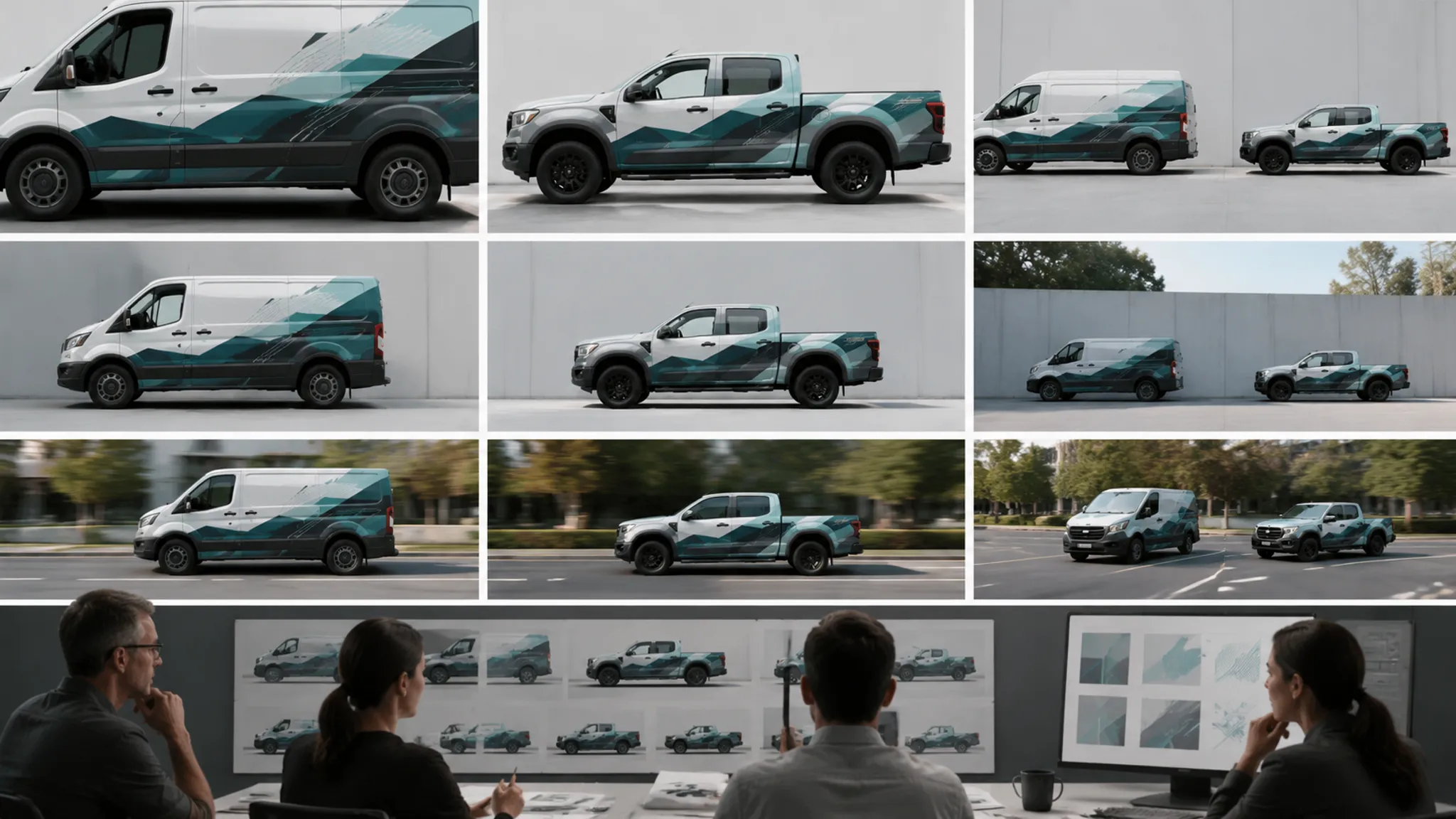
A hierarchy survives adaptation when the viewer can still identify the intended first, second, and third visual signals. Review the same order in four conditions.
Stationary Side View
Inspect the full profile at a close working view. Look for a mark cut by a door seam, a stripe that changes direction without a clear reason, text sitting too close to the wheel arch, a sponsor mark becoming larger than the primary identity, or a color block ending before the body zone feels complete.
This view reveals construction conflicts, but it does not settle motion legibility.
Reduced-Size View
View the mockups together at a smaller size. Assess the large shapes first. If the identity disappears when the mockup is reduced, additional small text will not repair the hierarchy.
Distance View
Place the mockups at the approximate review distance selected for the concept. Treat this as an observation of the render, not proof of real-world visibility.
Record what remains readable and what collapses into color or shape. A large primary mark may survive while a service descriptor disappears; that may be acceptable, but the decision should be explicit.
Motion-Oriented View
Use stills or a simple simulated pass-by comparison when the project includes that review condition. The purpose is to see whether the main identity appears in the expected order as the profile is encountered.
One profile is not the fleet.
This comparison remains concept-stage visual analysis. Road-use visibility, local requirements, measurements, material behavior, color tolerances, permissions, preflight, and installation questions require current topic-specific documents and confirmation from the responsible designer, producer, installer, vehicle owner, rights holder, or applicable authority.
Use Body Zones in the Handoff
“Put it on the side” is not a useful instruction when several surfaces interrupt the side view. Name the body zone and its relationship to nearby features.
- Front door or rear door
- Cab side or bed side
- Tailgate or rear quarter
- Wheel arch, glass line, beltline, or door seam
- Lower rocker area or upper rear panel
Terminology may vary between design, vehicle ownership, production, and installation teams. A body-zone inventory reduces ambiguity when the mockup moves toward measurement or panel mapping.
For each major element, record its intended zone, nearby contour or break, whether it may cross that break, whether the placement is fixed or adaptable, and who must confirm the final location.
This separates the visual concept from the vehicle-specific file. The designer can show the intended relationship while the producer or installer confirms actual panel conditions.
Compare Colorways and Sponsor Tiers
A colorway review should compare relationships before debating exact reproduction. In the mockup, inspect dominant and secondary areas, contrast between identity and body surface, the visibility of the recurring accent, and the way doors or panels fragment a color block.
A colorway that feels balanced across the cargo van may become top-heavy on a pickup when the lower bed side carries most of the saturated area. Another variant may preserve the color relationship while making the primary identity less prominent.
Record the visible effect:
- The pickup bed carries more of the accent color.
- The primary mark has less surrounding space.
- The lower stripe is interrupted by the wheel arch.
- The cab reads clearly, but the bed loses the shared gesture.
These observations do not establish print accuracy or material behavior. Current specifications, tolerances, substrates, and production conditions belong in the relevant project record.
Sponsor placement requires the same comparison discipline. Start with the agreed sponsor tiers, then record which marks must remain prominent, which may move between zones, which require surrounding space, and which changes require sponsor or rights-holder confirmation.
A mockup can propose a movement. It cannot establish that a mark may be used, altered, resized, or relocated.
Record the Vehicle Profile Tradeoffs
Every variant gives something and takes something. Record the exchange instead of calling one version simply better.
| Variant choice | What it preserves | What it risks |
|---|---|---|
| Keep the full van stripe | Immediate system similarity | Awkward breaks at doors or wheel arches |
| Shorten the stripe | Better fit to the profile | Weaker connection to the reference vehicle |
| Keep the large identity block | Stronger first read | Less room for supporting information |
| Reduce the identity block | More balanced body coverage | Lower prominence at distance |
| Use the bed for the main gesture | Longer visual movement | Greater separation from cab identity |
| Use the cab for the main identity | Concentrated recognition area | Less graphic presence on the rear half |
| Customize each rear treatment | Better vehicle-specific composition | More revision and approval work |
The selected direction should state what it protects and what remains unresolved.
Run a Repeatable Mockup Review
- Establish the reference. Identify the primary identity, recognition structure, information layer, sponsor tier, and supporting detail on the current reference vehicle.
- Map each profile. Mark doors, windows, wheel arches, seams, handles, lights, accessories, and other visible interruptions. Treat this as a planning map; template and measurement confirmation remain separate tasks.
- Place the hierarchy. Place the primary identity first, recognition structure second, then information, sponsor marks, and supporting detail. Remove detail when the composition fails before additions begin.
- Compare shared conditions. Show variants at the same mockup scale, angle, and background treatment where possible. Inspect close, reduced, distance, and motion-oriented views.
- Record visible tradeoffs. Tie each note to a feature: “The pickup preserves the primary mark but loses the long side gesture.”
- Assign dependencies. Route composition and revision logic to the designer; configuration to the vehicle owner; files and production requirements to the producer; surface concerns to the installer; permissions to the rights holder; and current road-use questions to the applicable authority or responsible project reviewer.
A handoff is reviewable when the next person can see both the chosen direction and the unresolved dependency.
Common Failure Signals
The Artwork Is Copied Without Adaptation
The same artwork appears on every vehicle, but body breaks create different emphasis. The vehicles remain related while their visual hierarchy diverges.
The Entire Graphic Is Reduced
Scaling preserves proportions but may make the identity too small for the intended viewing condition. Compare a scaled version with a selectively simplified version.
The Stripe Controls the Layout
A strong graphic gesture can become the dominant feature after adaptation. Check whether the primary identity still arrives first.
Information Fills Every Panel
Additional space invites additional text. Resist that expansion when it weakens recognition or creates inconsistent information density between classes.
Sponsor Marks Become Decoration
A convenient location may still conflict with the stated sponsor tier or require permission. Record the proposed placement and the owner of confirmation.
The Mockup Is Treated as a Production File
A render can show an intended relationship. It does not establish measurements, material suitability, color reproduction, permissions, road-use requirements, preflight status, or installation status.
What a Reviewable Handoff Contains
The concept package should make the decision legible without suggesting that downstream work is complete.
- One reference mockup and one mockup for each vehicle class
- A short hierarchy statement
- A body-zone placement record
- Notes on preserved and changed elements
- A comparison of the main visible tradeoffs
- A revision identifier and date supplied by the project team
- Open questions and the responsible reviewer for each
- Any supplied vehicle references, brand guidance, sponsor records, or current production documents used by the team
State the remaining dependencies specifically: measurement, material behavior, color tolerances, rights permissions, road-use requirements, preflight, and installation review. Those questions stay with the responsible source or reviewer.
FAQ
Should every vehicle in a fleet use the same graphic layout?
Not necessarily. Preserve the same hierarchy and recognizable system while adapting placement to each vehicle profile.
How do you adapt a cargo-van fleet graphic to a pickup?
Separate the van’s primary identity, recognition structure, information, sponsor tier, and supporting detail. Then compare which elements belong on the cab, bed, tailgate, or other body zones. Do not assume that shrinking the complete van layout will preserve its visual order.
What should remain consistent across vehicle classes?
The project record should identify the elements intended to carry recognition, such as the primary identity, recurring color relationship, graphic gesture, sponsor structure, or information order. Mark each as fixed, adaptable, or unresolved.
How should vehicle-specific measurements enter the workflow?
They should enter after the concept identifies intended body zones and relationships. Current vehicle information and responsible-party measurement records must confirm actual panel conditions before production decisions are made.
How can a mockup reveal a weak variant?
Compare variants at the same angle and scale, then reduce them and inspect them at a distance. Look for a missing first read, broken recognition shape, crowded sponsor tier, or information that disappears as the profile becomes smaller.
Does a mockup establish road-use visibility or compliance?
No. It provides a concept-stage visual comparison. Applicable requirements and local conditions require current sources and responsible-party confirmation.
Can sponsor marks be moved between vehicle classes?
A mockup can propose a movement, but permission and placement conditions must be confirmed through the relevant sponsor, rights holder, vehicle owner, or project record.
When is a vehicle-class variant ready for concept handoff?
When the selected direction, visible tradeoffs, revision record, body-zone intent, and unresolved dependencies are clearly recorded. That status is different from production or installation readiness.
Final Decision
Choose the variant that preserves the intended hierarchy under the same viewing conditions, not the one that copies the reference drawing most literally.
On the cargo van, the graphic may rely on a continuous side field. On the pickup, it may need a cab-led identity, a shortened gesture, or a selective rear treatment. Record what remains recognizable, what changes because of the body shape, and which questions still require measurement, rights review, production confirmation, road-use review, preflight, or installation input.
Record the tradeoff. Assign the next handoff.
Sources
- Automotive graphic sticker design: variation, interaction and perception
- Visual Communication in Shared Mobility Systems as an Opportunity for Recognition and Competitiveness in Smart Cities
- A preliminary study on the integration of engineering and aesthetics measures via the design of vehicle silhouettes
- Information on the road: towards a methodology for the study of truck art
These sources provide bounded context for visual variation, recognition, vehicle differentiation, and observation methods. They do not establish vehicle-specific measurements, material suitability, permissions, road-use requirements, color accuracy, preflight status, or installation readiness.