Distance and Speed Legibility Review
A racing livery can look resolved in a garage mockup and lose its hierarchy as the vehicle moves away. The close view shows finish, spacing, and panel detail; the distance view tests whether the main identity still arrives first.
The useful decision is not which colorway looks more exciting. It is whether the same visual order survives on the intended vehicle profile, at the relevant viewing distance, through simulated motion, and within likely camera framing.
Fast verdict: compare variants under matched conditions, record what remains distinguishable, and separate visible evidence from production questions. A mockup can expose a hierarchy problem. It cannot establish final fit, material behavior, event requirements, road-use status, or rights permission.
What Racing Livery Visibility Actually Tests
Racing livery visibility concerns whether a concept communicates its intended priorities under changing viewing conditions. Those priorities may include the team colorway, competition number, vehicle identity, primary sponsor tier, and secondary sponsor locations.
Begin with the livery visual hierarchy:
- What appears first?
- What remains distinguishable at distance?
- Which marks lose contrast or merge with the bodywork?
- Does the vehicle still read as one coherent profile from front, side, and rear angles?
- Do panel breaks, wheel arches, vents, glass lines, and door seams interrupt the intended order?
This is a concept-stage review, not a universal visibility formula. The result changes with the vehicle silhouette, lighting, background, camera position, display size, and available viewing time.
Read order matters most.
A large primary mark may remain recognizable while smaller sponsor tiers disappear. A strong base color may identify the team while the number loses tonal separation. A dense side graphic may look detailed at close range but become an undifferentiated band during a brief view.
Run a Static vs Simulated-Motion Livery Read Test
Use the same livery variants under the same distance, angle, lighting, and motion conditions. This creates a useful source-based comparison of observable outcomes, but it should not be presented as a validated scientific protocol.
1. Start with the stationary mockup close-range review
Inspect front, side, rear, and three-quarter views at a comfortable close distance. Confirm that the mockup represents the intended vehicle profile, including body lines, wheel arches, windows, panel breaks, vents, and major contours.
- Primary and secondary sponsor tiers
- Number shape, placement, and contrast
- Door and hood placement
- Tonal separation between graphic elements and body color
- Interference from wheel arches and panel breaks
- Text density around doors, side skirts, bumpers, and rear surfaces
- Repeated identification locations across the vehicle
A close view helps locate collisions and alignment problems. It is a poor substitute for distance recognition.
A larger sponsor mark may gain visual weight but reduce breathing room near a door seam. A smaller mark may preserve the panel composition but lose recognition sooner. Record the tradeoff instead of treating size as an automatic improvement.
2. Repeat the comparison at distance
Reduce the mockup to the approximate size and distance that represent the intended review context. Keep angle and lighting consistent between variants. Display size and viewing conditions also affect what the observer can distinguish.
Ask an observer to identify only the information the concept is intended to communicate:
- Is the main colorway still distinguishable?
- Is the competition number recognizable?
- Can the primary sponsor tier be separated from the surrounding graphic?
- Does the side silhouette retain a clear body line?
- Does the rear view preserve the intended identification order?
A livery that depends on every small sponsor being read at once may carry too much information for the available viewing time.
Distance exposes hierarchy. The result may differ by angle. A mark that reads on the door can disappear behind the wheel arch, while a hood graphic can lose separation from a front three-quarter view.
3. Introduce simulated motion
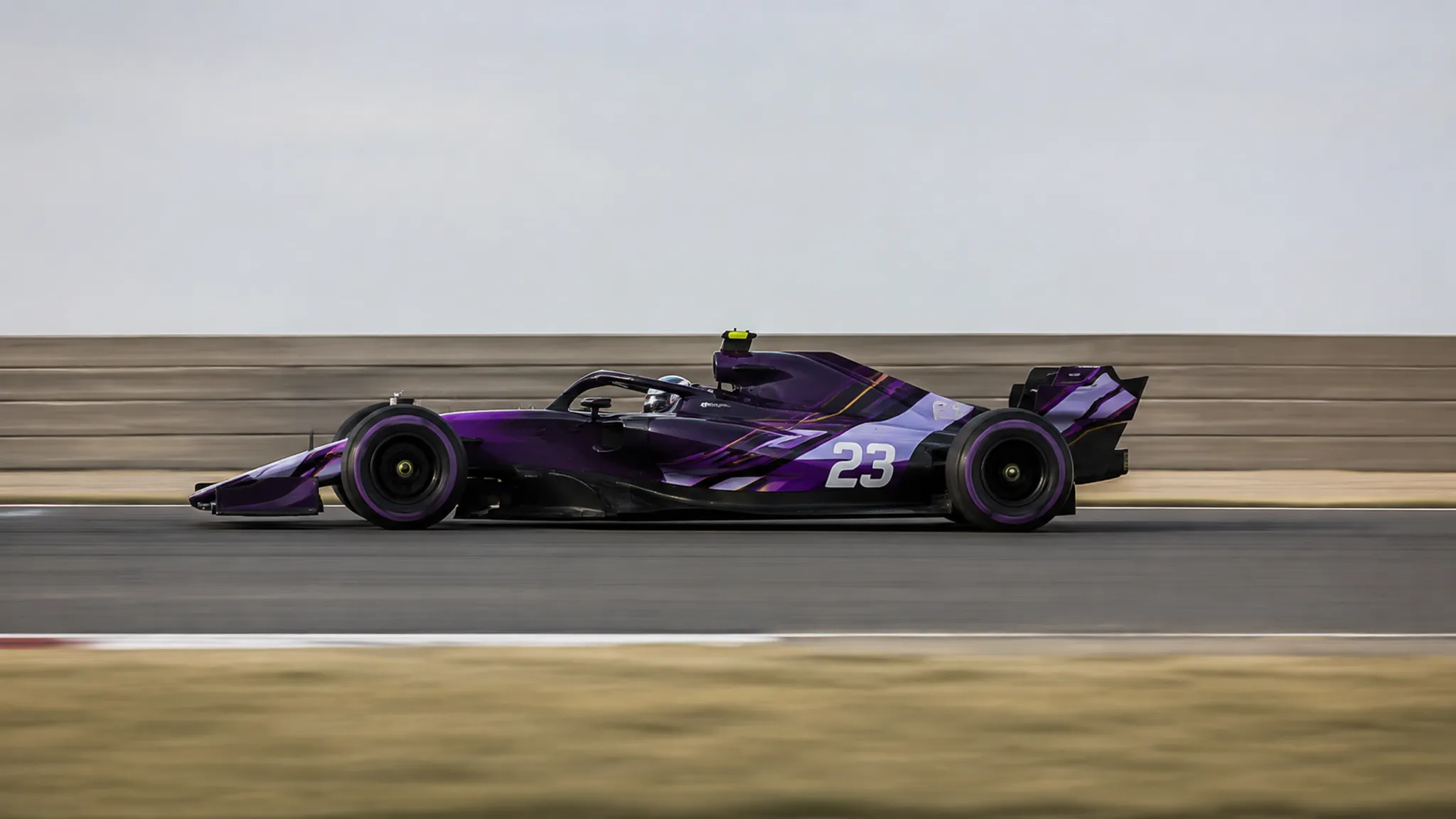
A simulated-motion livery read test can use a turntable, controlled animation, or a moving sequence of the same concept-stage render. Keep movement, camera framing, and playback conditions matched across variants.
Observe whether:
- The primary colorway remains identifiable during the pass
- The number appears in more than one useful view
- The sponsor hierarchy survives a short glimpse
- Stripes or repeated patterns merge into visual noise
- A panel break changes the apparent direction of a graphic
- The rear and side views communicate the same identity
- The camera-facing surface receives more attention than the hidden surface
Motion adds a time constraint. Human-factors research on display systems describes motion-induced blur as dependent on the application, task, contrast, luminance, resolution, and viewing conditions. That mechanism helps explain a loss of edge definition, but it does not establish a racing-vehicle speed threshold.
Do not turn a simulated result into a statement that the livery remains readable at a particular speed. The available material does not provide an independently verified field test for racing-livery recognition across a stated speed, distance, vehicle profile, or broadcast setup.
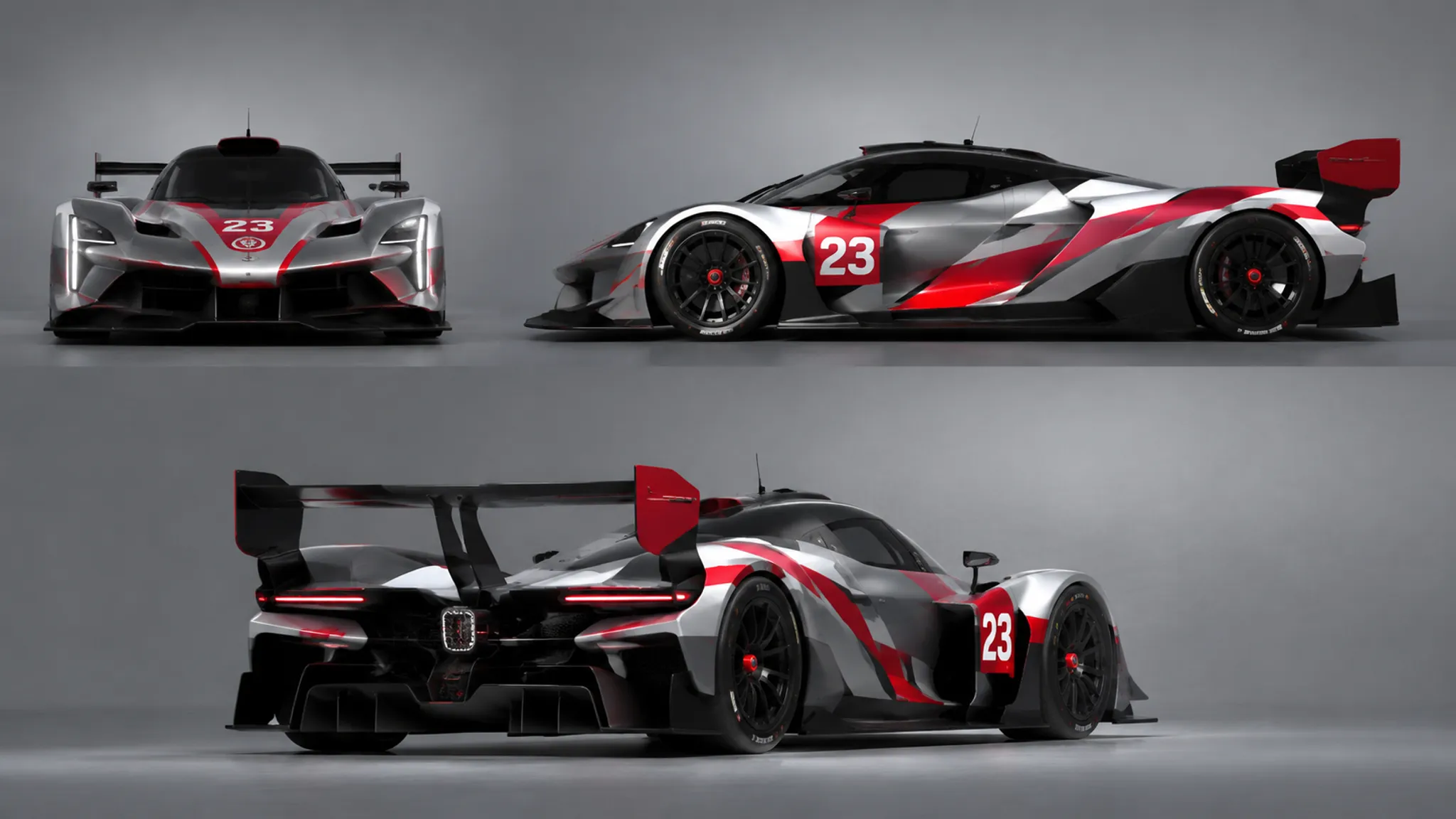
4. Compare front, side, and rear livery views
Treat each major view as a separate communication condition. A livery does not have one fixed reading when the vehicle is encountered from different directions.
Front view. The front usually offers less surface area than the side. Check whether the number, base color, and key identity elements remain separated around the grille, nose, headlights, and hood contours.
Side view. The side often carries the largest sponsor field, but it also contains doors, wheel arches, side skirts, vents, and strong body lines. Check whether these features support the hierarchy or cut through important marks.
Rear view. The rear may appear for a shorter period or from a narrower angle in a moving sequence. Inspect number recognition, color separation, and the relationship between rear graphics, lamps, diffuser forms, and panel boundaries.
Three-quarter views. These views reveal more of the vehicle at once, but they can conceal the relationship between a graphic and the body line it crosses. Use more than one angle when the decision concerns the whole profile.
The visible tradeoff is often uneven coverage. A variant may communicate strongly from the side and weakly from the front. Record that asymmetry instead of allowing a favored hero angle to represent the entire concept.
How Distance Changes Sponsor Mark Recognition
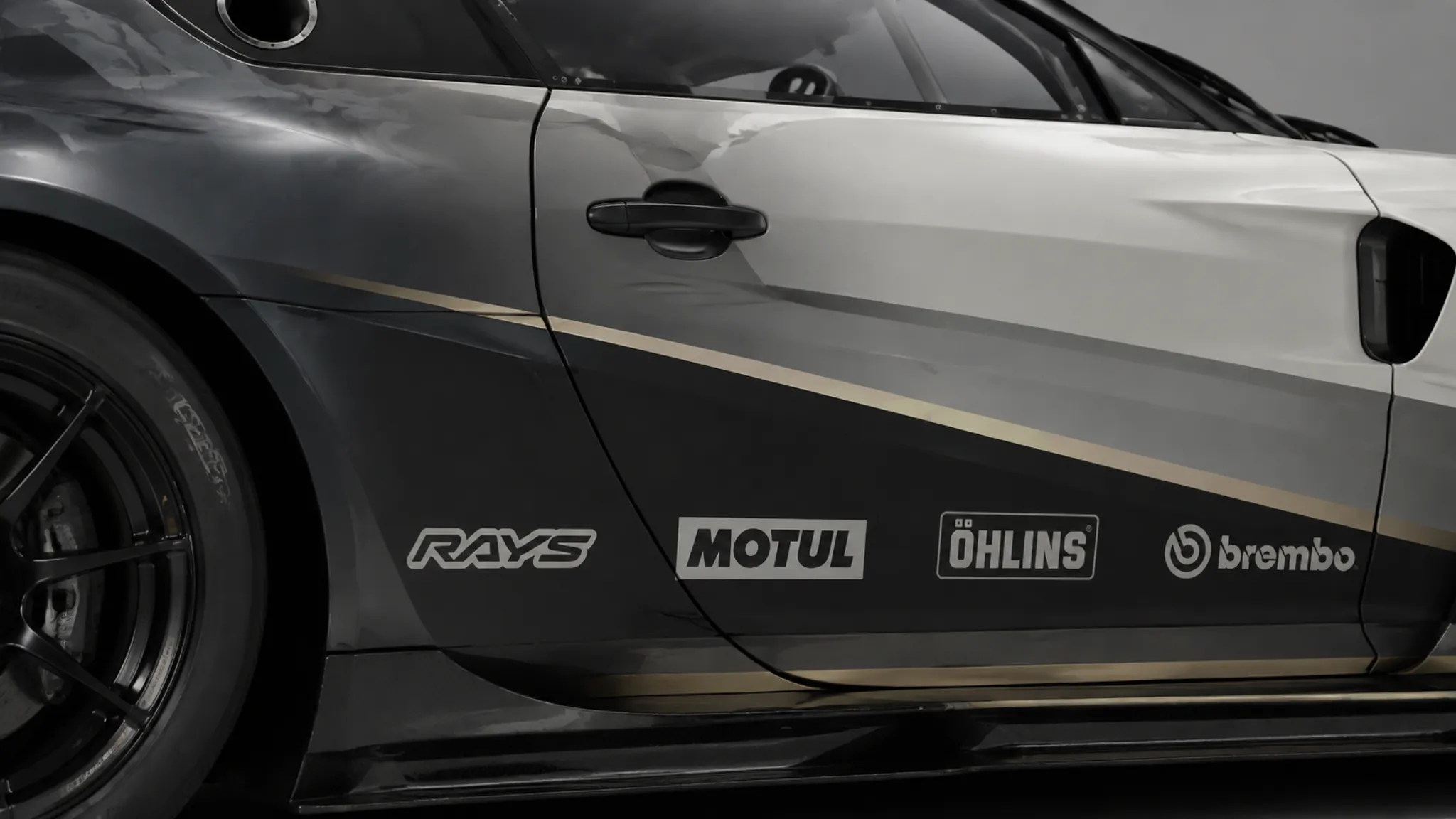
Sponsor mark distance recognition depends on more than nominal size. Contrast, surrounding color, graphic complexity, viewing angle, and the time available to see the vehicle all affect what remains distinguishable.
W3C guidance treats contrast as a contributor to legibility and recognizes the influence of text size, surrounding colors, and visual conditions. That is a useful boundary for livery review: tonal separation can support recognition, but a digital-content contrast reference does not certify a vehicle graphic.
| Review question | Observable mockup signal | Follow-up owner |
|---|---|---|
| Does the primary sponsor remain distinct? | The mark separates from the base color at the tested distance | Designer and vehicle owner |
| Does a secondary tier support rather than compete? | Smaller marks remain grouped without overtaking the main identity | Designer and team |
| Does the number survive motion? | The form remains distinguishable across repeated views | Designer; confirm project conditions |
| Does a panel break interrupt the mark? | A seam, arch, or contour cuts through a key letter or symbol | Designer and installer |
| Does the rear carry too much information? | Text and marks collapse into one dense block | Designer and vehicle owner |
These observations come from the mockup. They do not establish commercial exposure, broadcast performance, or sponsor value.
A sponsor mark can be visibly present without being visually useful. If its size, contrast, or placement causes it to merge with adjacent graphics, the concept may need a hierarchy revision even though the mark occupies the intended panel.
Tonal Separation in Racing Liveries
Tonal separation describes how clearly adjacent graphic areas distinguish themselves by lightness and darkness. Color difference can also matter, but appearance changes with lighting, surface curvature, display conditions, and camera treatment.
A practical review uses the same colorway in several restrained comparisons:
- Full color under the chosen mockup lighting
- A reduced-color or grayscale inspection for light-dark separation
- Front, side, and rear views
- Close and distance scales
- Stationary and simulated-motion states
The grayscale view is a diagnostic aid, not a complete prediction. It can reveal where adjacent areas share similar tonal weight, but it cannot represent every chromatic relationship or the behavior of the finished material.
A vivid accent may attract attention at close range while disappearing into a similar-toned body area at distance. A dark block may separate clearly from a light base but dominate the side profile and compress the sponsor tiers around it.
Contrast supports order, not meaning. A high-contrast mark can still sit behind a wheel arch, split across a door seam, or lose emphasis from an unfavorable camera angle. Review contrast together with geometry and view direction.
Wheel-Arch Interference and Panel Geometry
Vehicle surface geometry changes perceived hierarchy. Curved bodywork can stretch, compress, or redirect a graphic. Panel breaks can divide words and symbols, while wheel arches can remove continuity from a side mark.
Inspect each major graphic against the actual profile shown in the approval mockup:
- Follow the body line through the graphic.
- Check the mark at the door opening and seam.
- Inspect the area above and behind the wheel arch.
- Review vents, handles, lamps, and glass lines as interruptions.
- Compare the same element on front and rear doors where applicable.
- Confirm that the graphic's apparent direction still matches the vehicle contour.
A single three-quarter angle can conceal some relationships, while multiple views expose more of the form. If the question concerns side-panel hierarchy, the side view must carry the decision. If it concerns whole-vehicle recognition, use a sequence that includes front, side, rear, and changing angles.
A concept mockup can reveal likely interference. Exact production mapping, stretch, overlap, material suitability, and installation tolerance belong in the vehicle-specific handoff.
Static Versus Simulated-Motion Livery Comparison
Static and simulated-motion reviews answer related but different questions.
| Condition | What it can show | What it cannot establish |
|---|---|---|
| Close stationary view | Detail, spacing, seams, mark collisions, and tonal relationships | Distance recognition or motion behavior |
| Distant stationary view | Broad hierarchy and major colorway recognition in the mockup | Performance under real track conditions |
| Simulated motion | Whether hierarchy survives a short moving sequence or changing angle | A universal speed or viewing threshold |
| Camera-framed view | How cropping and angle alter the visible order | Actual broadcast or livestream results |
| Front, side, and rear sequence | Directional consistency and repeated identification locations | Final event presentation or regulatory acceptance |
Do not use the close view to settle a motion question. Do not use a moving render to settle a production question.
A static version may show a small sponsor mark clearly because the viewer has time to inspect it. The same mark may disappear in a simulated pass, leaving only the base color and primary number. That is a useful concept observation, not a measured claim about recognition at a specified speed.
Broadcast Framing and Camera-Facing Surfaces
Broadcast framing can change which parts of a vehicle are visible and how long they remain in frame. Photography, trackside viewing, television, and livestream views may present different crops, angles, and distances.
Use likely framing as a review prompt:
- Which side of the vehicle faces the camera?
- Does the main sponsor sit inside the visible crop?
- Does the number appear before the vehicle exits the frame?
- Does a wheel arch or door seam interrupt the camera-facing mark?
- Does the rear view preserve the same identity order as the side view?
- Does the concept still read when only part of the vehicle is visible?
Formula One liveries can illustrate the cultural importance of team color, identity, and sponsor hierarchy, but those examples remain specific to Formula One and its media environment. A familiar colorway is not a transferable layout for another series, category, or vehicle profile.
Treat phrases such as “broadcast visibility” or “stand out” as review language unless project records define the camera, lens, distance, lighting, frame rate, and evaluation method. The available research does not provide a livery-specific broadcast field test.
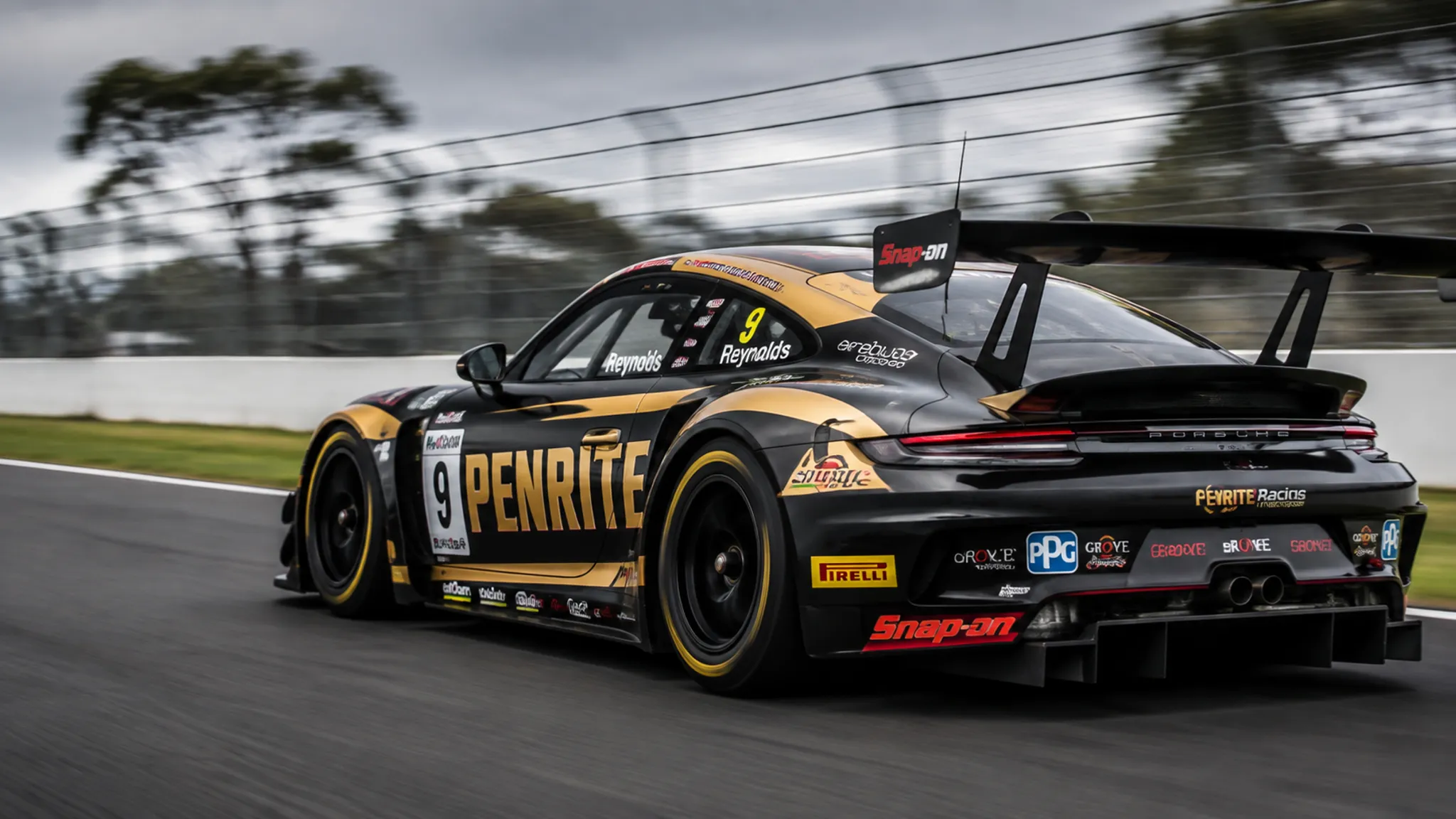
Common Misreads During Livery Review
“It reads in the garage, so it will read in motion.”
A garage close-up provides generous viewing time and controlled attention. It can hide weak distance recognition, lost contrast, and sponsor marks that merge during movement.
“More contrast always solves the problem.”
Contrast can improve separation between adjacent areas, but it does not resolve poor placement, panel interference, excessive text density, or an inconsistent front-to-rear hierarchy.
“The largest mark should occupy every important surface.”
A larger mark can gain recognition in one view while reducing breathing room or disrupting the body line. Compare the gain against the loss on the same profile.
“A famous racing colorway proves the structure works.”
A known example communicates cultural familiarity, not a transferable rule. The intended vehicle, series, sponsor tier, and viewing system still control the review.
“A simulated motion render proves real-speed legibility.”
Simulation can expose a hierarchy change under a chosen playback condition. It does not replace vehicle-specific observation, current project records, or responsible-party review.
“The mockup settles approval.”
The mockup can support a concept decision. Measurement, production preflight, rights permission, material and installation questions, road-use review, and event requirements remain separate decisions.
Record the Decision, Not Just the Preference
A review record should make the comparison repeatable for the next handoff. Capture the variant, vehicle profile, view, distance, lighting, motion state, and camera framing used for each observation.
Use concise decision language:
- “Variant B keeps the primary colorway distinct in the distant side view.”
- “Variant A preserves more space around the door seam.”
- “The number remains distinguishable in the simulated front pass.”
- “The secondary sponsor tier merges with the wheel-arch graphic from the rear three-quarter view.”
- “The mockup does not establish material behavior or installation tolerance.”
“More distinguishable in this mockup” is stronger editorial language than “high-speed readable” when no project-specific test supports the latter.
End the record with unresolved dependencies:
- Designer: revise hierarchy, number form, tonal separation, or panel placement.
- Vehicle owner or producer: confirm the vehicle specification, measurements, and required production assumptions.
- Installer: review material behavior, panel mapping, seams, overlaps, and installation constraints.
- Series or event organizer: confirm current marking, number, branding, and presentation requirements.
- Team or rights holder: confirm sponsor, trademark, and image permissions.
What the Evidence Can and Cannot Tell You
The strongest available sources support bounded mechanisms rather than livery-specific conclusions. Contrast guidance can explain why separation between foreground and background matters for legibility. Human-factors and display research can explain why motion blur changes with task and viewing conditions. Government traffic-visibility guidance provides adjacent context, but it is not a racing-livery standard.
Official motorsport regulations are the appropriate source for current series-specific requirements. A document for one series or season cannot establish the current rules for another series or event.
The public reference coverage remains narrow. No supplied source provides an independently verified field test of racing-livery recognition across a stated speed, distance, vehicle profile, or broadcast setup. The right output is therefore an observable comparison, a documented tradeoff, and a clear handoff.
FAQ
What is a static livery read test?
It is a concept-stage comparison of the same livery or competing variants while the vehicle remains stationary. The reviewer checks close, distant, and multiple-angle views for hierarchy, contrast, number recognition, sponsor separation, and panel interference.
What is a simulated-motion livery read test?
It is a controlled moving sequence of a mockup or vehicle render used to observe whether the intended hierarchy survives changing angle and limited viewing time. It is a workflow label, not a universal test method.
How should I review livery readability across distance?
Hold variants under matched distance, angle, lighting, and display conditions. Record which elements remain distinguishable and where marks merge, lose contrast, or disappear behind body features.
Should the front, side, and rear use the same graphic hierarchy?
They should communicate a coherent identity, but the visible order may adapt to each surface. Available area, curvature, panel breaks, and camera exposure differ by view.
Does a high-contrast racing livery automatically read better?
No. Contrast can support separation, but placement, size, text density, viewing angle, lighting, and vehicle geometry also influence the visible result.
Can a mockup prove broadcast framing livery visibility?
No. A mockup can show how a chosen crop and angle affect the visible hierarchy. Actual broadcast or livestream performance requires project-specific camera conditions and responsible-party confirmation.
What should happen after the review?
Record the chosen direction, observed tradeoffs, and unresolved dependencies. Send design revisions to the designer, measurement and production questions to the producer or vehicle owner, installation questions to the installer, current sporting requirements to the organizer, and sponsor or trademark questions to the rights holder.
Closing Checkpoint
Choose the variant whose hierarchy remains most coherent under the intended review conditions, while recording what the mockup does not establish.
The review is complete when the record names the visible reason for the decision, preserves the matched comparison conditions, and assigns each unresolved question to its next responsible owner.
Sources
- Understanding Success Criterion 1.4.3: Contrast (Minimum)
- The Impact of Motion-Induced Blur on Visual Performance
- Factors Affecting Sign Visibility, Conspicuity, and Legibility: Review and Annotated Bibliography
- Effects of Content and Viewing Distance on the Preferred Size of Moving Images
- FIA International Sporting Code
- 2025-2026 FIA Formula E World Championship Sporting Regulations