Team Identity and Competition Number Review
On the side mockup, the competition number may appear settled. Check the front, rear, and motion-oriented views before recording that decision, because panel breaks, sponsor blocks, and changing contours can alter the read.
Race car number design works as part of a team identity system. The useful question is not which number style looks best in isolation, but which variant keeps the identifier distinct while preserving sponsor hierarchy and a workable handoff.
- Which variant remains identifiable across the required vehicle views?
- Which placement supports team recognition without weakening sponsor priorities?
- Which decisions still require vehicle measurement, current rulebook review, rights confirmation, production input, or installer review?
Start with matched conditions. Hold the vehicle profile, scale, crop, camera angle, lighting treatment, and background steady. A changed viewing condition can make one variant appear stronger without changing the underlying composition.
What the Review Should Establish
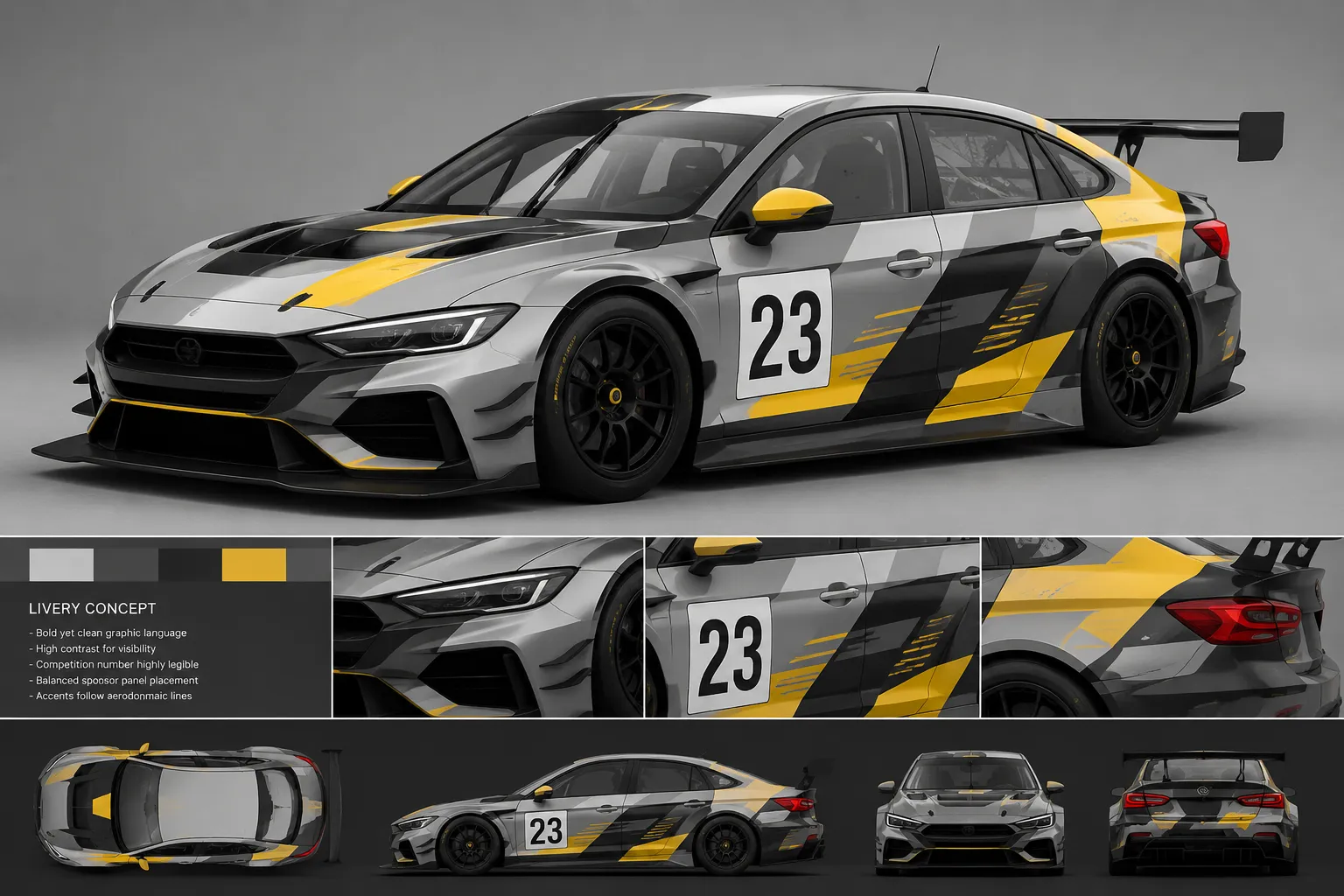
A concept-stage mockup can show how the number separates from the body color, how it relates to panel geometry, and whether the identity system repeats across the vehicle. It can also reveal where a sponsor block, stripe, or contour competes with the identifier.
It cannot establish a current series requirement, a vehicle-specific measurement, material suitability, print accuracy, installation success, or permission to use sponsor and trademark assets. Those questions belong to the applicable sanctioning body, event organizer, designer, producer, installer, vehicle owner, sponsor, or rights holder.
The mockup settles direction, not production. Record what the image demonstrates and keep the unresolved dependencies beside that visual decision.
Competition Number Isolation Across Race Car Views
Competition number isolation is the separation between the identifier and the visual information around it. Contrast matters, but color alone does not decide whether the number holds its place in the composition.
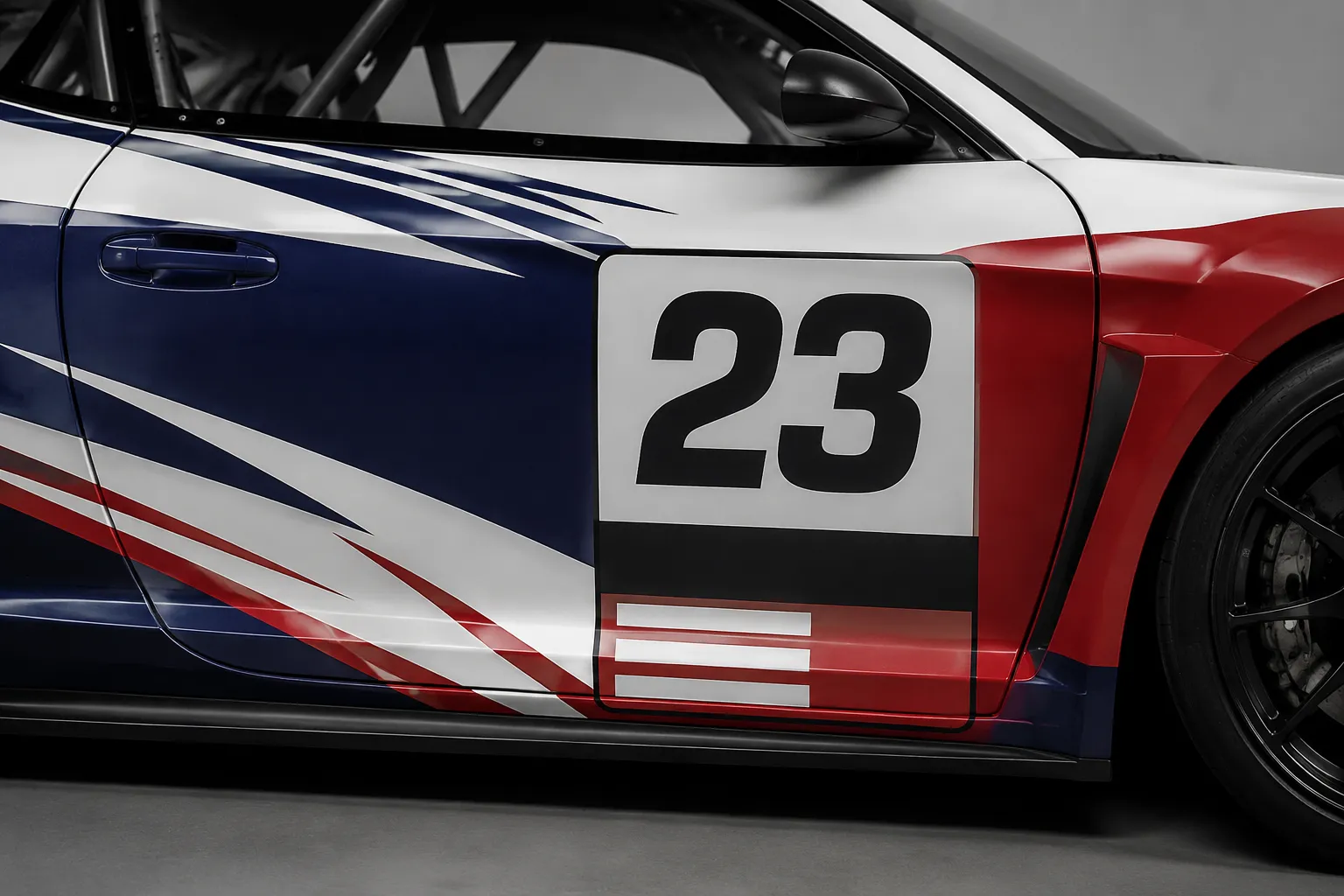
- Body color: Compare the number fill, outline, and surrounding field against the actual proposed colorway. A curved surface may change the apparent relationship between nearby tones.
- Panel breaks: A door seam, bonnet gap, or rear hatch break can interrupt the rhythm of a digit. The mark may remain present while reading as disconnected fragments.
- Wheel arches and contours: Strong boundaries can compete with the number shape or reduce the uninterrupted area available for several digits.
- Glass lines: Window edges and windscreen strips may frame the identifier, but their contrast can also pull attention toward the glass line.
- Sponsor blocks and adjacent graphics: Several logos can weaken hierarchy even when the number remains visibly different from the body color.
Inspect the whole local composition rather than searching for a universally strongest color combination. The available material does not provide an independent visibility study or a measured comparison that supports such a conclusion.
Isolation must survive context.
Compare Front, Side, Rear, and Motion Views
Each vehicle view answers a different identity question. Keep the same two variants under the same conditions, then record where hierarchy holds and where it changes.

Front View
The front view tests whether the number remains part of the team system when the side panel is no longer visible. A narrow nose or tapering contour may compress a number that appears balanced on a flat artwork canvas.
- Is the complete number visible from the intended front-oriented view?
- Do the digits face the viewing direction used for comparison?
- Do headlights, vents, stripes, or sponsor marks compete with the identifier?
- Does the graphic remain coherent across the front contour?
- Does the applicable series document specify, restrict, or otherwise control this area?
Discussion about front-view legibility can introduce useful review terms such as camera angle or narrowing bodywork. It does not establish a verified dimension or a universal front-placement rule.
Side View
The side view places the door, driver area, rear quarter panel, and sponsor field in one composition. Familiar door number placement may support recognition for some audiences, especially where a category has established visual conventions.
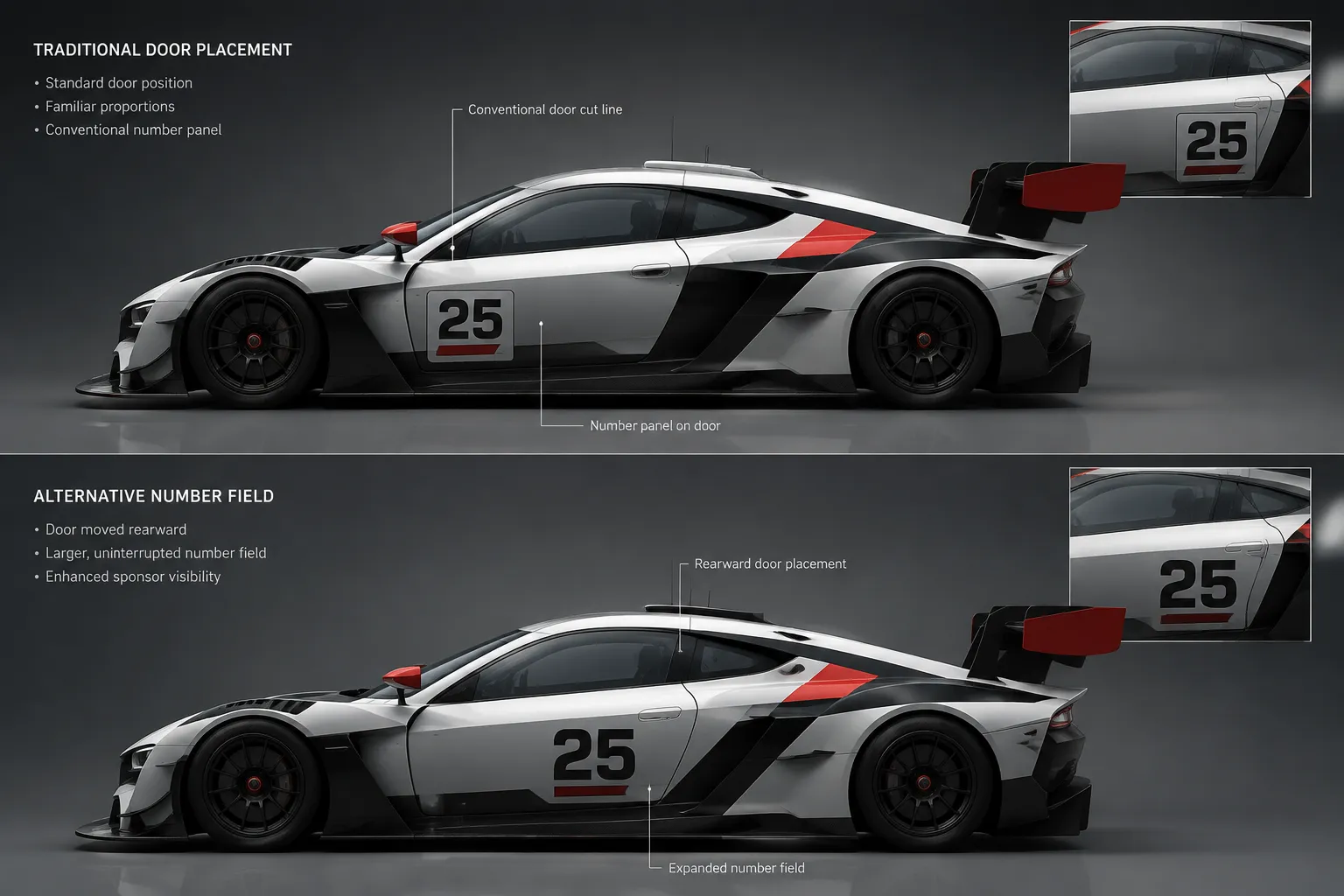
That convention still needs testing on the selected vehicle profile. A door seam, handle, contour, or primary sponsor may compete with the expected anchor. Moving the identifier toward the rear quarter can create a broader uninterrupted field, but it also changes the familiar side-view relationship.
Compare a traditional side placement with an alternative shaped by the available panel area. Keep the crop and scale fixed, then write down the tradeoff rather than naming a universal winner.
Rear View
The rear view tests whether the identifier remains connected to the team after the car passes or turns away. Bumpers, wing elements, lights, diffuser zones, and exhaust openings can divide the available surface.

- Does the number remain separate from rear hardware and strong horizontal edges?
- Does the rear treatment repeat the intended identity hierarchy?
- Do sponsor marks overwhelm the team identifier?
- Is the number visible in the rear-oriented condition being reviewed?
- Does a current rulebook or event appendix control the proposed location?
Consistency does not require copying the same scale onto every surface. A rear view may need a simpler arrangement because its panel geometry and viewing direction differ from the side.
Motion-Oriented View
A motion-oriented render or perspective crop is a review condition, not a field test. Use the same crop for both variants and inspect whether the number survives changing orientation, compression across the contour, and competing graphics.
Research on racing-image analysis treats orientation, crop, and image conditions as separate variables. That supports comparing several views independently, but it does not establish a human viewing-distance threshold or prove that a proposed design remains legible during competition.
Motion exposes hierarchy.
Competition Number Hierarchy and Team Identity
Hierarchy asks what a viewer should recognize first, second, and third in each vehicle view. A typical review may coordinate the team identity, competition number, primary sponsor, secondary sponsor tier, class or driver information, and supporting colorway elements.
The order can change by view. A side panel may give the number and primary sponsor equal priority, while a narrow front surface may need a simpler relationship. When every mark receives similar size, contrast, or edge weight, the viewer must resolve too many signals at once.
Sponsor Tiers and Number Placement
Number placement affects the commercial identity of the livery because the identifier occupies a limited visual field. Historical research on motorsport sponsorship describes livery as part of a wider communication system involving color, shape, vehicle position, clothing, transport equipment, and broadcast presentation.
That context does not establish sponsor exposure or business results for a proposed layout. It explains why relocation can create a genuine design conflict: the team may value familiar driver recognition, a sponsor may require a prominent panel, and the designer may need a larger uninterrupted field.
| Element | Intended role | View where it must read | Visible conflict | Next decision owner |
|---|---|---|---|---|
| Competition number | Vehicle identification | Required or selected front, side, rear, and motion views | Body color, seam, contour, or logo density | Designer and applicable sanctioning body |
| Primary sponsor | Main commercial identity | Principal side or front field | Number scale or graphic overlap | Team and sponsor |
| Secondary sponsor | Supporting recognition | Selected side, rear, or detail areas | Competing logo density | Team and designer |
| Class or event marking | Series-specific information | Required location, if applicable | Number or body contour | Event organizer or sanctioning body |
| Decorative graphic | Colorway and visual continuity | All selected review views | Interrupted number isolation | Designer |
This ledger organizes a concept review; it does not replace the governing document. Any required placement, marking, advertising treatment, or inspection provision must be checked against the current applicable rule set.
Number Placement and Panel Geometry
Vehicle surfaces are not neutral rectangles. The body line, door seam, wheel arch, glass line, and contour change how a number appears from the view that matters.
Straight-Sided Areas
An uninterrupted panel can preserve the shape of several digits and separate them from nearby graphics. It may also carry the strongest sponsor demand, creating a direct choice between identifier space and commercial hierarchy.
Narrow or Tapering Areas
A tapering nose or rear quarter can make the number appear compressed or displaced from the intended center. Treat that as an observable condition on the chosen vehicle profile, not as a measured requirement.
Seams and Edges
A door seam can divide a digit or place a strong line between two characters. An edge can also create a useful boundary against a sponsor block. Mark these conditions on the approval mockup so the producer and installer can relate the artwork to panel mapping, measurements, finishing, and installation constraints.
Follow the panel, not the canvas.
Race Car Number Mockup Comparison
A compact comparison record keeps the visual choice connected to the work that remains open.
- Freeze the viewing conditions. Use the same vehicle profile, camera angle, crop, scale, lighting treatment, and background for every variant.
- Name the identity anchor. State what the viewer should recognize first in each view. This is a concept decision, not a determination of what the series requires.
- Inspect the isolation points. Note where the number separates from or merges with body color, panel breaks, wheel arches, glass lines, sponsor blocks, stripes, and background patterns.
- Change one meaningful variable. Compare placement, surrounding field, outline treatment, sponsor density, or colorway while keeping other conditions steady.
- Write the tradeoff. For example, one variant may preserve familiar door placement while sharing space with the primary sponsor. Another may create a larger number field while moving the identity anchor toward the rear quarter.
- Add a contamination prompt where relevant. Dirt, glare, blur, or partial occlusion can change what appears in a racing image. Ask which digit loses recognition first, but do not turn that prompt into a material-performance conclusion.
- Assign the next handoff. Give each unresolved question to the person or organization able to answer it.
Designer questions usually concern hierarchy, colorway, and panel-aware revision. The vehicle owner can confirm the vehicle profile and use scenario. The producer handles file specifications and preflight questions; the installer addresses surface, fit, panel mapping, and installation constraints. The sanctioning body or event organizer controls current marking requirements, while sponsors and rights holders address permissions and approved assets.
Fleet Consistency Across Different Vehicles
A multi-car team needs more than repeated colors. It needs a repeatable relationship between the number, sponsor tiers, and team identity across different body shapes.
- Does the number occupy a comparable identity position on each profile?
- Does the sponsor hierarchy remain recognizable?
- Does the colorway preserve the intended recognition order?
- Do different wheel arches, window lines, or panel breaks require visible adaptation?
- Is each variation intentional and recorded?
Fleet consistency does not require identical placement on every vehicle. A touring-style body, prototype, or smaller car may offer different usable surfaces. The review should distinguish deliberate adaptation from accidental drift.
Keep one shared identity record with the selected concept variants, vehicle-specific mockups, number hierarchy, sponsor-tier logic, geometry conflicts, revision versions, and unresolved rulebook or production questions.
Familiar Door Placement: Tradition Versus Fit
Traditional door placement can carry recognition and cultural meaning in some racing communities. Reader discussions often connect it with driver memory, sponsor value, and familiar viewing angles, but those associations do not form a measured preference study or a rule for every category.
Compare two directions under the same conditions:
- Familiar placement: retains an established side-view anchor, but may compete with seams, handles, contours, or sponsor space.
- Alternative placement: may create a broader uninterrupted field or better follow the body contour, but can reduce the recognition value associated with the traditional door position.
The record should name the vehicle profile, identity priority, sponsor arrangement, and applicable series requirements behind the choice. The visible tradeoff belongs in the approval note.
Current Series Rulebook Lookup
Check the current rulebook beside the mockup review. The cited Formula One, FIA GT World Cup, and IMSA documents illustrate a bounded point: number treatments, supplied markings, advertising, placement, and inspection can depend on the series, class, event, appendix, and document edition.
Use the applicable document to verify:
- which series, class, event, or supplement governs the vehicle;
- which edition is current;
- whether an appendix specifies an exact location or treatment;
- whether supplied number markings are required;
- whether advertising provisions affect the available panel space;
- whether inspection or scrutineering checks apply.
An appendix may control the exact placement, so a summary should not be used to infer the position. A redline or historical issue should not be treated as the current requirement. Confirm the applicable provision, then have the responsible party compare it with the proposed concept.
A rulebook requirement is not concept approval.
Common Review Errors
Treating Contrast as the Whole Test
A number can contrast with the body color yet merge with a seam, sponsor block, or stripe. Inspect the surrounding composition at each required view.
Repeating Unverified Dimensions
Forum fragments may mention number heights, distances, or stroke values. Without a named series, current document, and applicable class, those figures should trigger a rulebook lookup rather than become recommendations.
Assuming Tradition Resolves Placement
Familiar door placement may support recognition for some audiences. It does not settle the fit of every vehicle profile or sponsor arrangement.
Using Commercial Workflow Terms as Evidence
Terms such as number kit, air-release vinyl, complete race package, or easy installation describe market language or workflow. They do not establish material behavior, fit, print accuracy, or installation success.
Reviewing One Angle Only
A side mockup can hide a front-view failure, while a front view can hide sponsor competition on the door. Keep the required views together.
Treating a Render as a Handoff
A concept render still leaves vehicle-specific measurement, panel mapping, rights review, file preflight, production confirmation, and installer input to the responsible parties.
Compact Sign-Off Record
Close the review with five fields:
- Chosen direction: name the variant and its main visible reason.
- View condition: state whether the decision holds in front, side, rear, motion-oriented, or multiple views.
- Visible tradeoff: record what improves and what becomes harder.
- Unresolved dependency: identify measurement, rulebook, sponsor, rights, material, production, or installation questions.
- Next responsible handoff: assign each question to the designer, producer, installer, vehicle owner, event organizer, sanctioning body, sponsor, or rights holder.
Variant B retains stronger number separation on the side and rear-quarter views at the reviewed mockup scale. It moves the familiar door anchor and needs sponsor review, vehicle-specific measurement, and confirmation against the applicable class provisions before the artwork advances.
This record describes the visible result without presenting the concept as authorized or ready for installation.
FAQ
What is competition number isolation?
It is the visual separation between the competition number and nearby body color, panel breaks, contours, glass lines, sponsor blocks, and decorative graphics. Review it across the vehicle views that matter for the project.
Is familiar door placement always the best choice?
No universal conclusion follows. Familiar placement may preserve a recognized side-view anchor, while another position may better fit the vehicle geometry or sponsor hierarchy.
How should I review race car number design from a distance?
Use a consistent mockup condition and compare the same crop and scale across variants. The available material does not establish a universal viewing-distance threshold, so distance should remain a project-specific review condition.
Do racing regulations use one number-placement standard?
No assumption should be made across disciplines. Requirements may vary by series, class, event, appendix, and document edition.
Can a mockup show that a number will remain readable during competition?
A mockup can reveal visible hierarchy and likely conflict areas from the shown view. It does not provide a controlled visibility study, field test, material validation, or installation validation.
What happens after the design review?
Record the selected direction, visible tradeoff, unresolved questions, and next owner. Route measurements, current rulebook checks, sponsor or rights permissions, production files, and installation matters to the responsible parties.
Sources
- 2025 FORMULA ONE SPORTING REGULATIONS
- 2025 FIA GT World Cup Sporting Regulations
- 2025 IMSA Sporting Regulations and SSR: VP Racing Sportscar Challenge
- RaceLens: A Machine Intelligence-Based Application for Racing Photo Analysis
- Beyond the Mud: Datasets and Benchmarks for Computer Vision in Off-Road Racing
- Motor racing, tobacco company sponsorship, barcodes and alibi marketing