Run a Static vs Simulated-Motion Livery Read Test
When a racing livery must work in both an approval mockup and a moving presentation, compare the same vehicle profile under the same viewing condition. Use the static view to inspect structure, then use simulated motion to see which parts of the hierarchy remain visible, soften, or disappear.
Verdict: keep the simulated-motion presentation only when it preserves the intended hierarchy at the matched view. A blurred render can show a presentation effect; it cannot establish how a physical wrap will appear at a particular speed, distance, light level, or camera position.
Set Up the Same-Condition Comparison
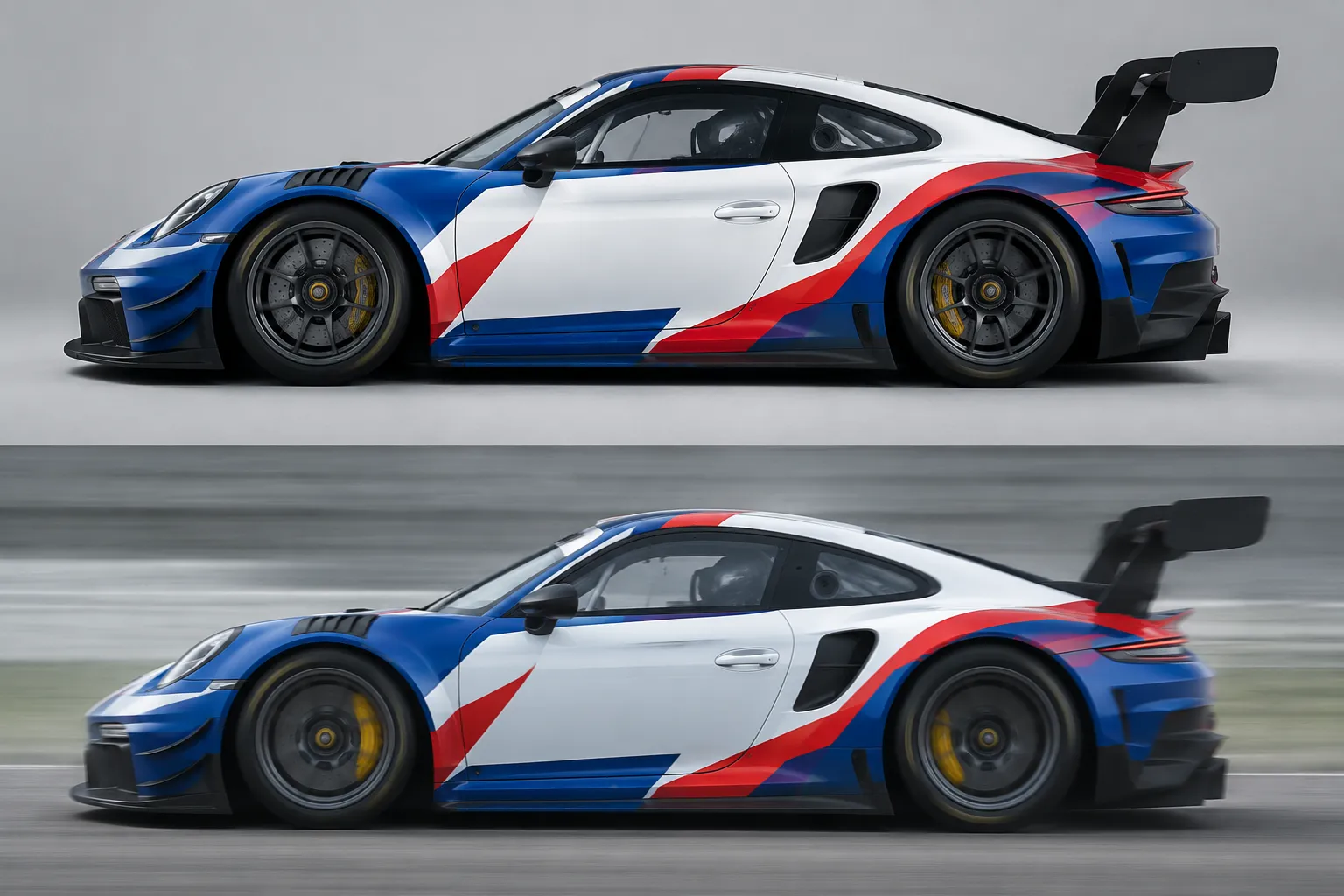
Choose one vehicle profile and one defined view. A side profile, front three-quarter view, or rear three-quarter view can work, provided both presentations use the same composition.
- Vehicle orientation, camera angle, and crop
- Apparent viewing distance
- Lighting direction and intensity in the presentation
- Background contrast
- Graphic scale and placement
- Visible wheel arch, glass line, door seam, and panel breaks
- Amount of motion treatment applied to the vehicle and background
These controls isolate the presentation change. A closer crop, brighter light, larger mark, or different angle can make one version seem stronger for reasons unrelated to motion.
Name the elements before reviewing them. Include the main color blocks, overall color rhythm, primary sponsor tier, secondary marks, driver or team lettering, key identifier, body-line relationships, panel breaks, wheel arch, glass line, and contrast around lettering.
That list keeps the review specific. “The motion version feels faster” describes a reaction, not a livery decision.
Read the Static Presentation First
The static view exposes the concept’s structure. Inspect whether the main color blocks establish a recognizable order across the hood, doors, quarter panel, roof, or rear body.
Find the first visual anchor. It may be a primary sponsor mark, a team color block, a number, or a strong graphic line. Then check whether the secondary elements support that anchor or compete with it.
Follow each graphic across the vehicle form. A stripe that appears continuous on a flat artboard may break at a door seam or change direction around a wheel arch. A sponsor mark may remain intact in the center of the door while becoming divided near a handle, contour, or panel edge.
The static livery read test should answer three questions:
- Can the viewer identify the main colorway?
- Can the viewer locate the primary identifier?
- Do the graphic lines follow the body form clearly enough to support recognition?
If the hierarchy is unclear while stationary, motion treatment is unlikely to solve the underlying ordering problem. It may add energy while hiding the point of failure.
Static checkpoint: establish the hierarchy before adding motion.
Test What Simulated Motion Preserves
Keep the vehicle arrangement stable while introducing directional blur, background streaking, wheel movement, or a moving-camera impression. Treat these as presentation conditions, not as evidence of physical performance.
Start with the broad read. At the chosen viewing distance, does the main color rhythm remain apparent? Do the major diagonals still direct the eye through the body? Does the livery retain a recognizable front-to-rear sequence?
Then inspect the smaller hierarchy. Check the primary sponsor tier against secondary marks. Look at lettering, numbers, narrow stripes, panel breaks, and key identifiers. These often soften before larger color blocks do.
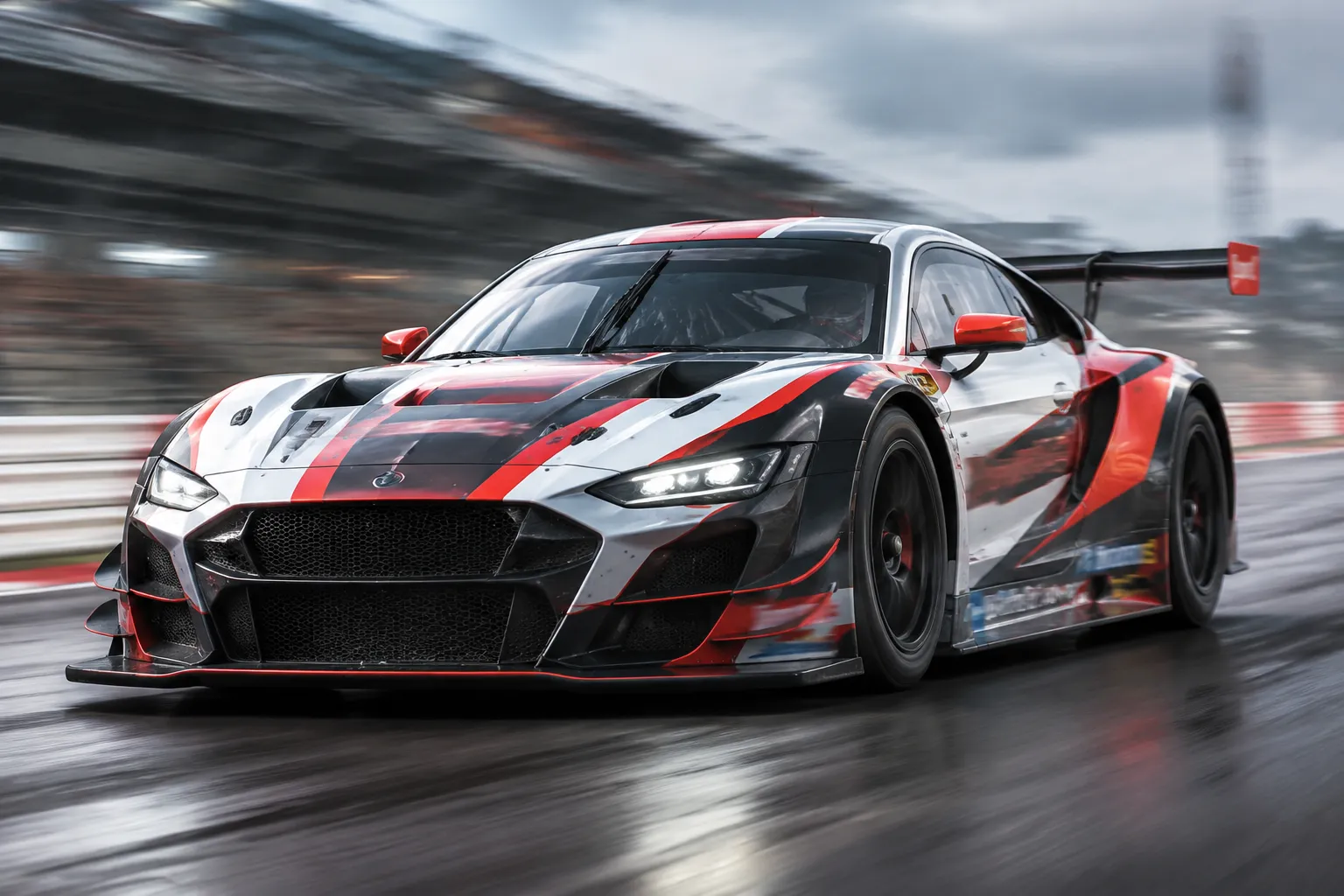
The visible tradeoff may look like this:
- Large color blocks retain their rhythm while small lettering loses grouping.
- A strong diagonal reinforces movement while crossing a sponsor mark.
- Background blur separates the vehicle from its surroundings while reducing edge definition.
- Wheel and body movement support speed language while obscuring lower-side graphics or the wheel arch.
- A cinematic crop increases visual energy while hiding a rear identifier or glass-line relationship.
Judge the information that survives, not the amount of blur.
Record Retained, Softened, and Lost Elements
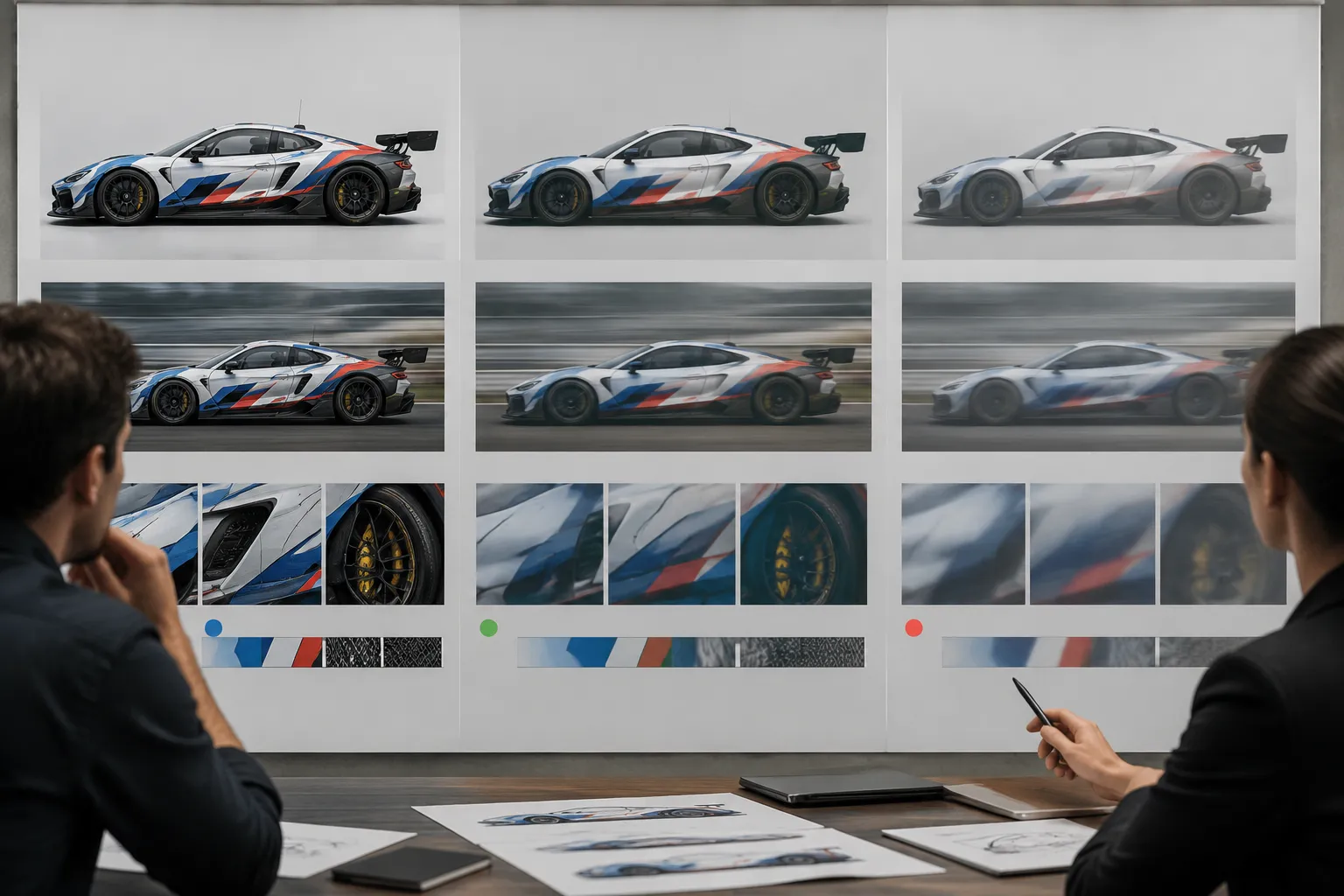
A recordable comparison is more useful than a single preference vote. Use the same categories for both presentations.
| Livery element | Static presentation | Simulated-motion presentation | Decision note |
|---|---|---|---|
| Main color blocks | Clear, partial, or unclear | Retained, softened, or lost | Does the colorway still identify the concept? |
| Primary sponsor tier | Clear, partial, or unclear | Retained, softened, or lost | Does it remain the dominant mark? |
| Lettering and numbers | Clear, partial, or unclear | Retained, softened, or lost | Does the treatment remove grouping or only fine detail? |
| Body-line relationship | Coherent or interrupted | Coherent, softened, or interrupted | Do the graphic lines follow the vehicle form? |
| Panel breaks | Visible or hidden | Visible, softened, or hidden | Do seams create accidental divisions? |
| Wheel arch and glass line | Clear or uncertain | Retained, softened, or lost | Does the treatment obscure vehicle structure? |
| Key identifier | Recognizable or uncertain | Recognizable, softened, or lost | Can the intended identifier still be distinguished? |
Use condition-specific wording. “Lost at this crop” identifies a revision target; “does not work” does not.
Main color rhythm retained at the matched three-quarter view. Primary sponsor remains identifiable, but side lettering softens in the simulated-motion version. The lower graphic crosses the wheel arch and loses continuity. Review lettering scale and the lower-side line before approval.
This note separates what the concept demonstrates from what still needs revision.
Why Blur Can Feel Right Without Improving the Read
Blur is often used to suggest speed, realism, excitement, or a cinematic presentation. Those terms describe an aesthetic intention. They do not show that the livery hierarchy has improved.
Adjacent perception research supports a narrower point: a viewer can notice a motion effect without gaining better performance on the information task. Research on blur and contrast also indicates that these changes can affect task-relevant precision, but it does not establish a universal threshold for racing-livery readability.
Research on simulated motion blur in a racing game is useful as a boundary, not as a vehicle rule. Its setting concerns a game, so it cannot determine how a physical wrap should be evaluated. Likewise, high-speed image-quality research shows why motion speed, lighting, capture behavior, direction, and evaluation criteria need to be defined before blurred images are compared. It does not provide a blur setting for livery review.
Use those sources to define caution. Do not turn adjacent-domain findings into a physical-livery formula.
When Each Presentation Leads
Let the static version lead when the decision concerns:
- Sponsor tier ordering
- Lettering placement
- Number or key identifier recognition
- Body-line alignment
- Panel-break conflicts
- Wheel-arch and glass-line relationships
- Colorway structure and revision details
Let the simulated-motion version lead when the decision concerns:
- Whether the overall color rhythm survives movement
- Whether a strong graphic line still directs the eye
- Whether the vehicle remains distinct from its background
- Whether motion treatment overwhelms smaller marks
- Whether the presentation communicates the intended speed language
- Whether the hierarchy changes between close inspection and distance viewing
Neither view replaces the other. The static presentation exposes construction and hierarchy. The simulated-motion presentation exposes presentation risk.
Keep Capture and Production Claims Separate
A physical-motion photograph introduces variables that a simulated render may not reproduce, including vehicle movement, camera movement, focus behavior, lens position, distance, and lighting. Record those conditions when a real capture forms part of the review.
Do not turn one photography comment into a universal camera setting. A result observed with one vehicle speed, lens, distance, or light level may not transfer to another project.
A vehicle-wrap visualizer can help place a concept on a vehicle form. It remains a concept-placement tool. It does not establish physical fit, material behavior, print accuracy, rights permission, installation status, or motion legibility.
Those questions belong in the relevant project handoff. Confirm measurements and material behavior with the producer or installer, capture conditions with the photographer, and permissions with the vehicle owner or rights holder.
Common Misreadings
“More blur means more speed.”
More blur may make an image feel more cinematic or energetic. It may also soften sponsor tiers, lettering, panel breaks, and key identifiers. Compare retained information, not emotional intensity.
“The static render is dead.”
A static presentation may feel less energetic while providing the clearest view of hierarchy and geometry. When the decision concerns placement or recognition, that clarity matters.
“A readable logo proves a readable livery.”
One large mark can remain visible while smaller lettering, secondary sponsors, numbers, and body-line relationships disappear. Review the hierarchy as a group.
“A motion test proves the physical wrap.”
It demonstrates one presentation condition. It does not establish physical appearance at a particular speed, distance, lighting condition, or camera position.
“One viewing angle is enough.”
A result belongs to the tested profile and crop. A front three-quarter view may preserve the main color block while hiding a rear identifier. Record the view instead of generalizing from it.
Record the Handoff
Save the static and simulated-motion presentations with the same crop and vehicle profile. Mark each reviewed element as retained, softened, or lost.
Then record three items:
- The hierarchy that remains visible in both presentations.
- The element that weakens or disappears under simulated motion.
- The person responsible for resolving the open question.
The designer may need to revise lettering scale, sponsor spacing, color contrast, or the relationship between a graphic line and a panel break. The photographer may need to document capture conditions. The producer or installer must confirm measurement, material, preflight, and installation questions. The vehicle owner or rights holder must address permissions where they apply.
The bounded decision is straightforward: retain the simulated-motion presentation when the intended hierarchy survives the matched condition. Revise or qualify it when blur communicates speed but weakens the marks the livery must carry.
Sources
- Motion blur in racing games
- Simulated motion blur does not improve player experience in racing game
- Effects of visual blur and contrast on spatial and temporal precision in manual interception
- Quality Assessment of High-Speed Motion Blur Images for Mobile Automated Tunnel Inspection
- Car Wrap Visualizer | Design Custom Vehicle Wraps | Avery Dennison | Graphics